
Perhaps I am an asshole.
When I wrote this reflection in October during Breast Cancer Awareness month, the public was inundated with pink. Pink T-shirts, pink pickleball sets, pink after-dinner mints at my local garage. My husband volunteers for Casting for Recovery, a program that teaches breast cancer patients to fly fish.
I am sick of pink.
When I was going through my rectal cancer journey as I described in my essay “Edna” (Fall/Winter 2025-26 Intima), every support group I participated in overflowed with breast cancer patients. It didn’t matter to me that breast cancer is three times more common in women than colorectal cancer. My jealousy made them seem cliquey, discussing mastectomies and losing their hair, which didn’t sound all that bad when I was soiling my pants. My oncologist confirmed that she’d heard breast cancer patients and colorectal cancer patients argue in support groups about who has the “worst” cancer. Breast cancer patients bemoaned not having the privacy of a hidden disability like an ostomy and colon cancer patients swore they’d go flat in an instant to get rid of the the bag.
My envy lasted until I read Dena Brownstein’s experience with breast cancer in the essay “Amazonia” (Spring 2022 Intima). As physicians forced into the role of patients, we both knew the withering fatigue, the constant fear, and the reactions to our atypical amputations. We understood $10,000 injections, the gratitude of having husbands that never left, the unexpected surprises of friends lost and gained. Brownstein, a former pediatric emergency physician, writes that the myth of a cancer patient undergoing a “hero’s journey” is a false one, and that illness is a “time warp, uninteresting but all consuming.” Her statement “Cancer was a trial, not a gift, and I am no stronger a person for having survived it,” rings as true to me as the bell at the end of radiation treatment.
Her wise conclusion reverberated too: “I learned that you can wander the labyrinth without assurance that you will find a way out, face your monsters, and emerge to reclaim your uncertain life.” Three years later, I have found that we share the same labyrinth, and my new, “uncertain life” is not quite as frightening. The blue of a colon cancer ribbon is lovely. So is pink.
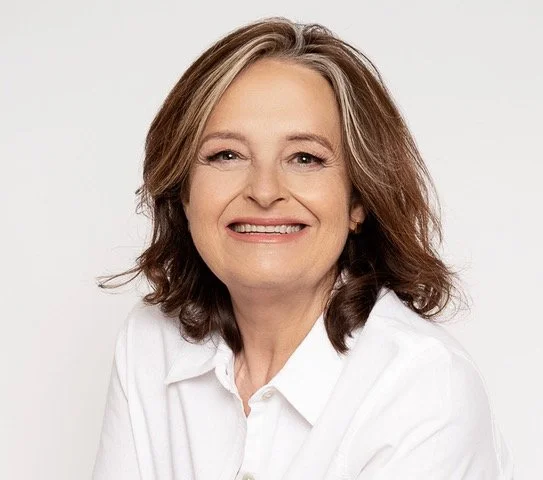
Ann Bebensee
Ann Bebensee is a retired neurologist and writer. Her work appears on The Keepthings. She lives in California with her husband and Bernese Mountain Dog. Her essay “Edna” appears in the Fall-Winter 2025-26 Intima: A Journal of Narrative Medicine.
