I confess I've been a book snob—snobbish about book clubbers who claim they've "read" a book after listening to it; snobbish about popular fiction vs literature and memoir vs biography—that changed when Rob Lowe's Stories I Only Tell My Friends came out in 2011. (Yes, I listened to it!) A bookworm from birth, I was a pretentious, bookish teenager. Pointing at Peyton Place on my mom's bedside table, I inquired why she was reading "that trash." Her snappish response—"Because I've read all the classics!"—took me down a peg. I couldn't make that claim.
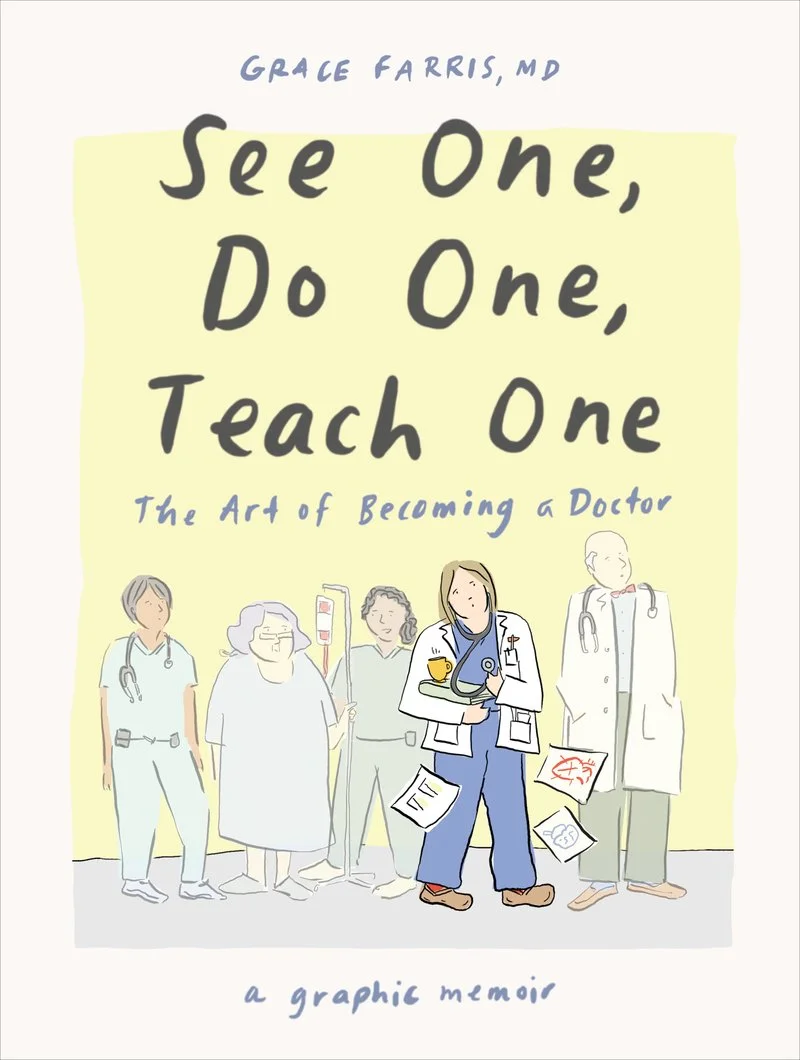
I'm telling you this as a lead up to another confession: I was a latecomer to the world of graphic memoirs and novels, being idiotically snobbish about the genre. A new graphic memoir See One, Do One, Teach One: The Art of Becoming a Doctor by Grace Farris would not have been on my bedside table ten years ago. I grew up in the Sixties reading newspaper comic strips like Nancy, a pudgy kid with a helmet-like hairdo who I sadly resembled. There was Beetle Bailey, then Doonesbury. I went through a Betty and Veronica phase, fancying myself as one or the other, depending on who Archie favored in the comic book series. How could I take a book made up of comic-strip panels seriously?
I read my first graphic book as a graduate student studying narrative medicine at Columbia University. Stitches (2009) is a heartbreaking novel by David Small about his childhood in 1950s Detroit that illustrates how a deeply felt story can be told visually—often more viscerally than in words. His graphic tale was groundbreaking then and is now considered an iconic graphic medicine book.
Many others have followed: Ian Williams's The Bad Doctor: The Troubled Life and Times of Dr. Iwan James; MK Czerwiec’s Taking Turns: Stories from HIV/AIDS Care Unit 371; Roz Chast's Can't We Talk About Something More Pleasant? about caregiving her aging parents; Kriota Willberg's instructive Draw Stronger: Self-Care for Cartoonists & Other Visual Artists that helped me as an editor to straighten up, rather than hunch over my laptop. For those still new to the genre, Graphic Medicine Manifesto provides an engaging introduction by practitioners in the field.
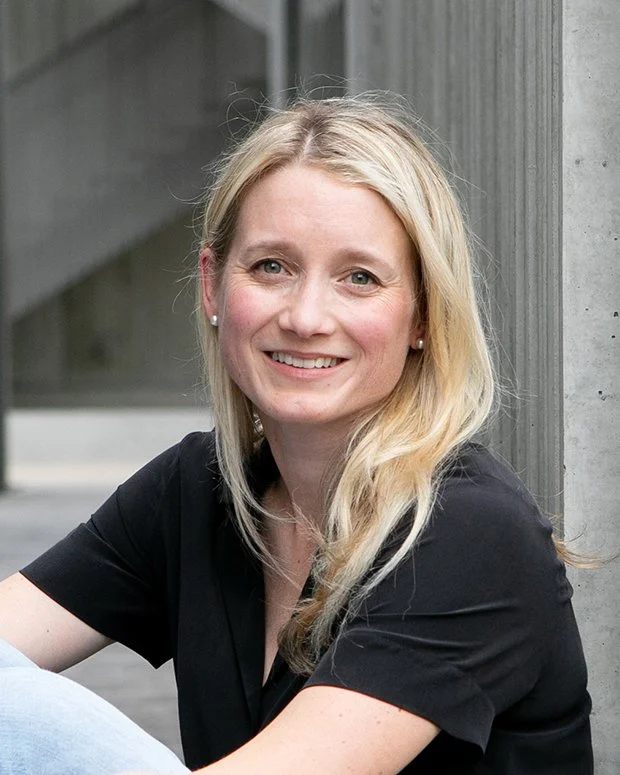
Grace Farris is a physician in Austin, Texas, and author–illustrator of Mom Milestones and More Than a Million. She is a contributor to Cup of Jo and NPR Health’s Shots, and her comics have appeared in the New York Times, Vogue, and in art exhibitions in the United States, Ireland, and Austria.
Photo by Sarah Natsumi Moore
Farris’s See One, Do One, Teach One is a memoir about becoming a doctor. It’s a timely book because enrollment in medical schools is up. After the pandemic, a few years of decline and a dip in med-school applications, people want to go into medicine again. The Association of American Medical Colleges (AAMC) reported last December that medical school enrollment topped a record high of 100,723 in 2025 (based on data collected from the 2025-26 application cycle), and women "accounted for 57.2% of all applicants." Apparently, 2019 was the first year when more women than men were enrolled in medical school, and the numbers have only increased since then.
Curiously, Farris's bildungsroman doesn't begin on the first day of medical school but with a Prologue where she and her husband are awaiting the birth of their child at her then workplace, Beth Israel Deaconess Medical Center in Boston. Farris has a rude awakening when she discovers how different it feels being on the other side of the doctor-patient equation, and that discomfort leads to some very funny and real epiphanies. It bugs her when the nurses call her Mom ("so infantalizing") and she has flashbacks to medical school when the metal hook ("that medieval gizmo") comes out to break her water. She can't believe the pain. "Becoming a patient made me want to rethink everything and reconsider my medical training" Farris says to herself. "What had just happened?"
It's a terrific segue to the memoir that follows—ten chapters split into three parts—Medical School: The Preclinical Years; Medical School: The Clinical Years; and Residency. Farris is an adept storyteller, which fans know from her first book Mom Milestones: The TRUE Story of the First Seven Years (Workman, 2022) and her new one about caregivers More Than a Million (Bloomsbury Children's Books, 2026).
Like those books, the pastel colorations and naive-seeming drawings in See One, Do One, Teach One make the narrative approachable, but it's Farris's honesty and the off-handed truth-telling of her musing mind that draws you in. Last year, Farris, who was a PLME student in Brown University’s Program in Liberal Medical Education, a highly selective, eight-year combined baccalaureate-M.D. program, was honored with Brown Medical Alumni Association’s Early Achievement Award—one of four awards presented during Reunion Weekend. She talked about the power of the pen. “Comics are a great way to explore complicated topics,” said Farris, a hospitalist and associate professor of internal medicine at the University of Texas at Austin. “You can make it more accessible for people and get at their emotions in interesting ways.”
I've read many stories, poems and essays about human anatomy class but Farris's approach to the dread, nausea, raw curiosity, jitters and childlike fascination with the cadaver felt original, even touching. We see her meeting her anatomy partners, Manny, Christina and Yamil, and feel the bonds forming between them as they confront fascia, bony landmarks, a human body that died of colon cancer and how the smell of formaldehyde permeates everything—clothes, hair, notes, etc. Throughout, Farris humanizes the surreal experience and her love of words reflects the intelligence behind the deceptively cute illustrations. When told she'll learn "more than 10,000 words this year," she muses "My favorite word so far is 'interstitial.' The between space."
Farris packs more information into each chapter than other narratives about medical training and delivers it in a way that's thoughtful and compelling for the general reader interested in an insider peek of the clinical world. Some parts read like a diary: “A Day in the Life of a Resident Doc" (see excerpt below) contrasts work and personal life, while other pages bring to life the weird cacophony of hospital rounds during her internal medicine clerkship, mirroring the frantic hospital soundtrack of The Pitt with its ding dings, Code Blues, crash carts and ER admissions, alongside lessons on how to read an EKG or what the first-line antibiotic for pneumonia is.
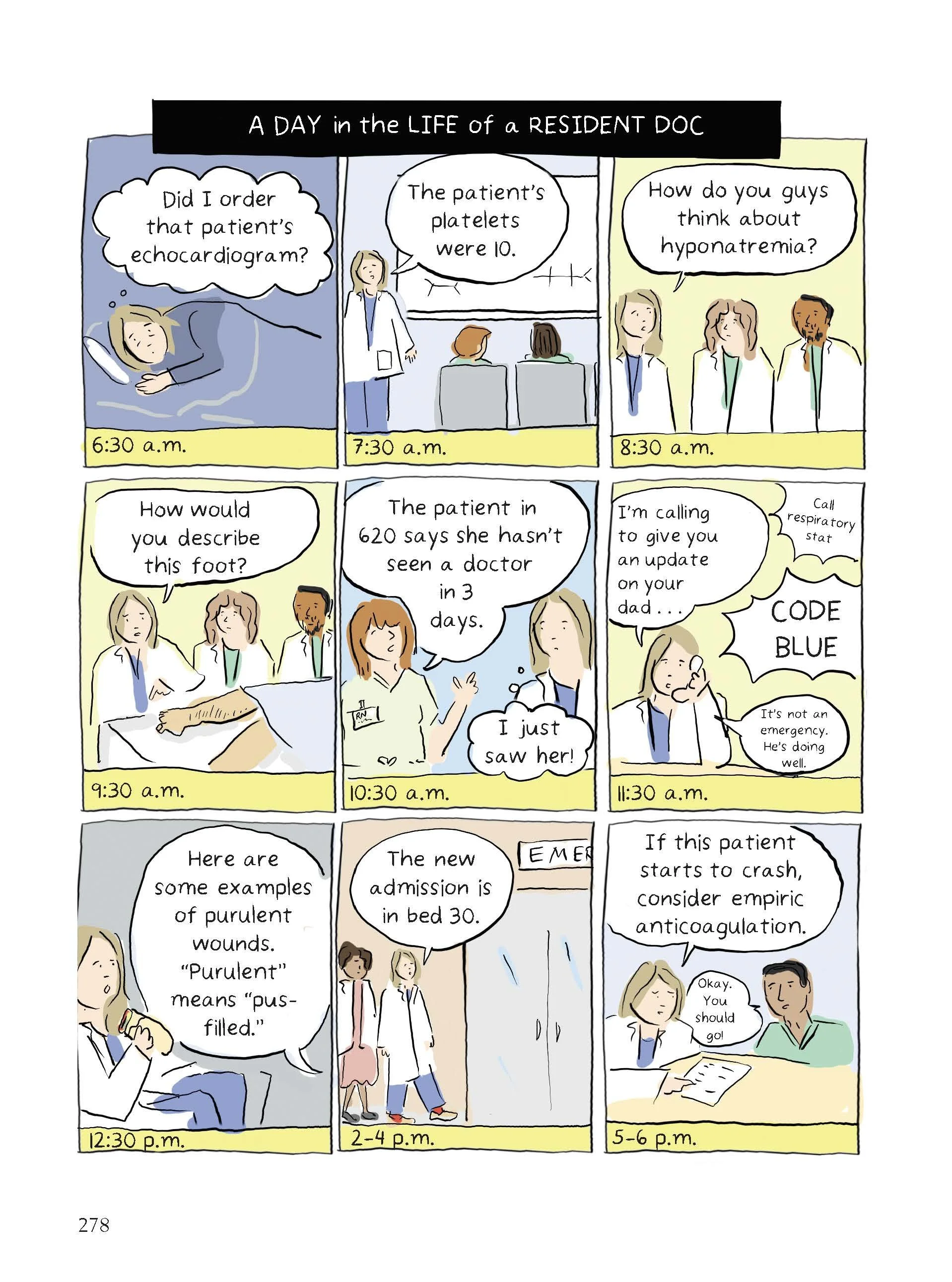
Excerpted from See One, Do One, Teach One: The Art of Becoming a Doctor: A Graphic Memoir. Copyright (c) 2026 by Grace Farris. Used with permission of the publisher, W. W. Norton & Company, Inc. All rights reserved.
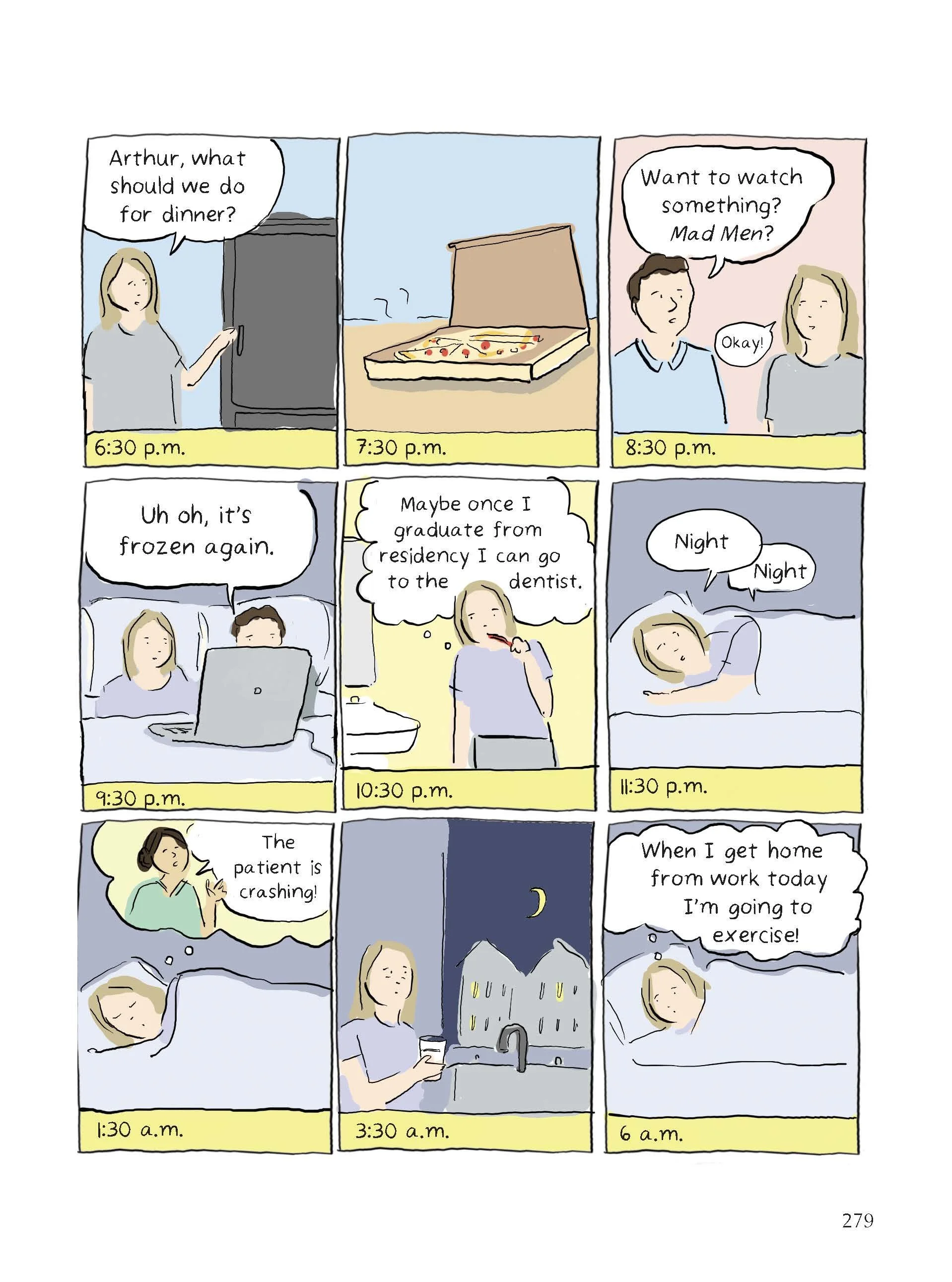
Excerpted from See One, Do One, Teach One: The Art of Becoming a Doctor: A Graphic Memoir. Copyright (c) 2026 by Grace Farris. Used with permission of the publisher, W. W. Norton & Company, Inc. All rights reserved.
What follows is entertaining and enjoyable, yet what See One, Do One, Teach One ultimately teaches us is how easily we relate to well-told stories, and especially one that delivers the touch-points of a life, like Farris's, showing how hard work and having a personal life, a sense of humor, reflection and creativity contribute to success. At the end of this graphic memoir, we sure know how grueling medical training is and all the guts and glory involved. We appreciate those wanting to join the ranks. But whether we're clinicians (I'm not), patients or a book snob, we've deepened our understanding and learned about its insular trappings — and also about the world in general. After all, that's why we read.—Donna Bulseco
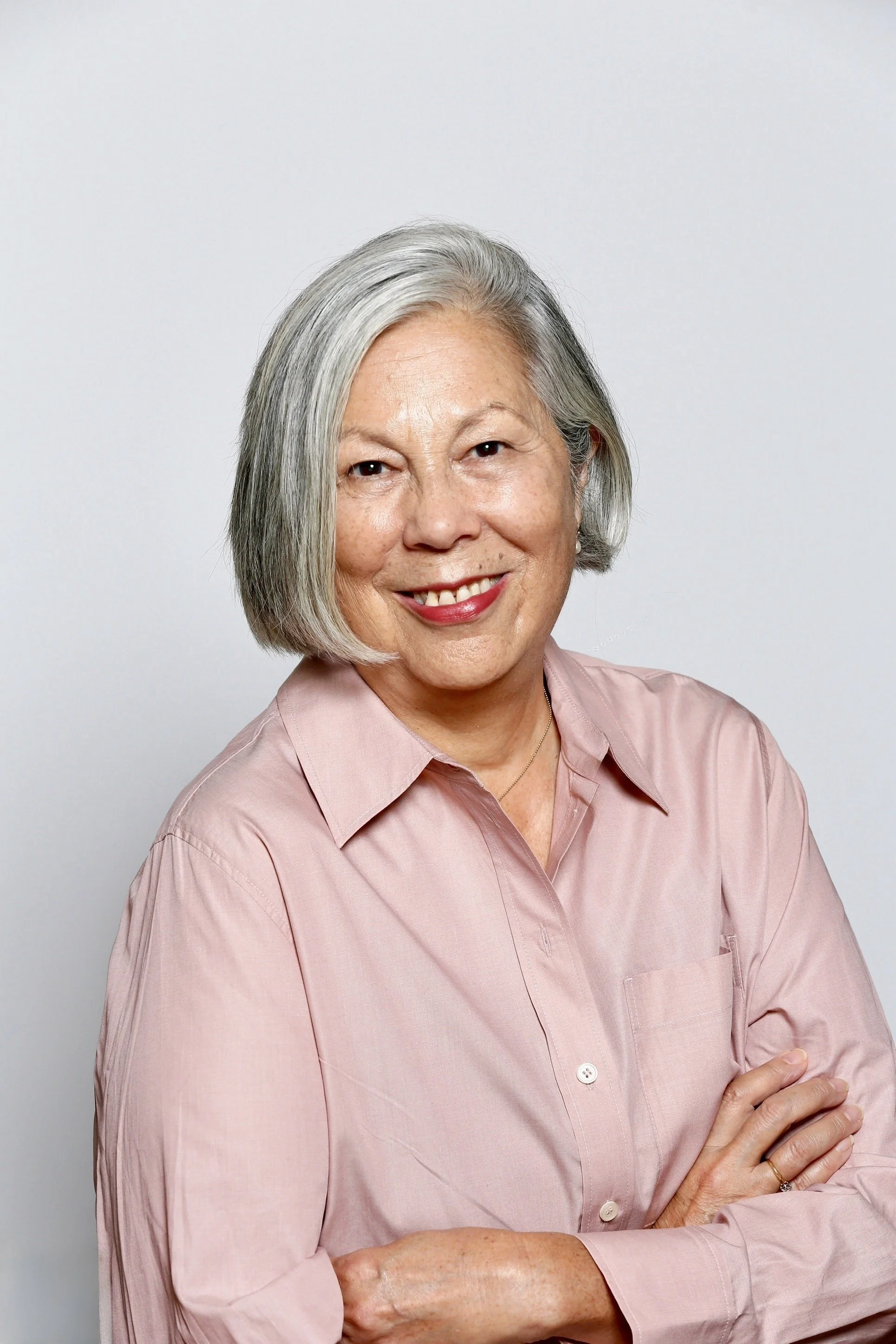
Photo by Kyle Ericksen
Donna Bulseco is a journalist and editor who holds graduate degrees in English from Brown University and in narrative medicine from Columbia University. Through the years, she has published work in The New York Times, Wall Street Journal, InStyle, Self, and The Purist. As editor-in-chief of Intima: A Journal of Narrative Medicine, a literary journal recognized as a leader in the medical humanities world, she works with an editorial board of clinicians, educators, and writers, who review and select from over one thousand submissions a year to produce the journal. Where It Hurts: Dispatches from the Emotional Frontlines of Medicine, a new anthology of work culled from the Intima archives was published by The Experiment.
