
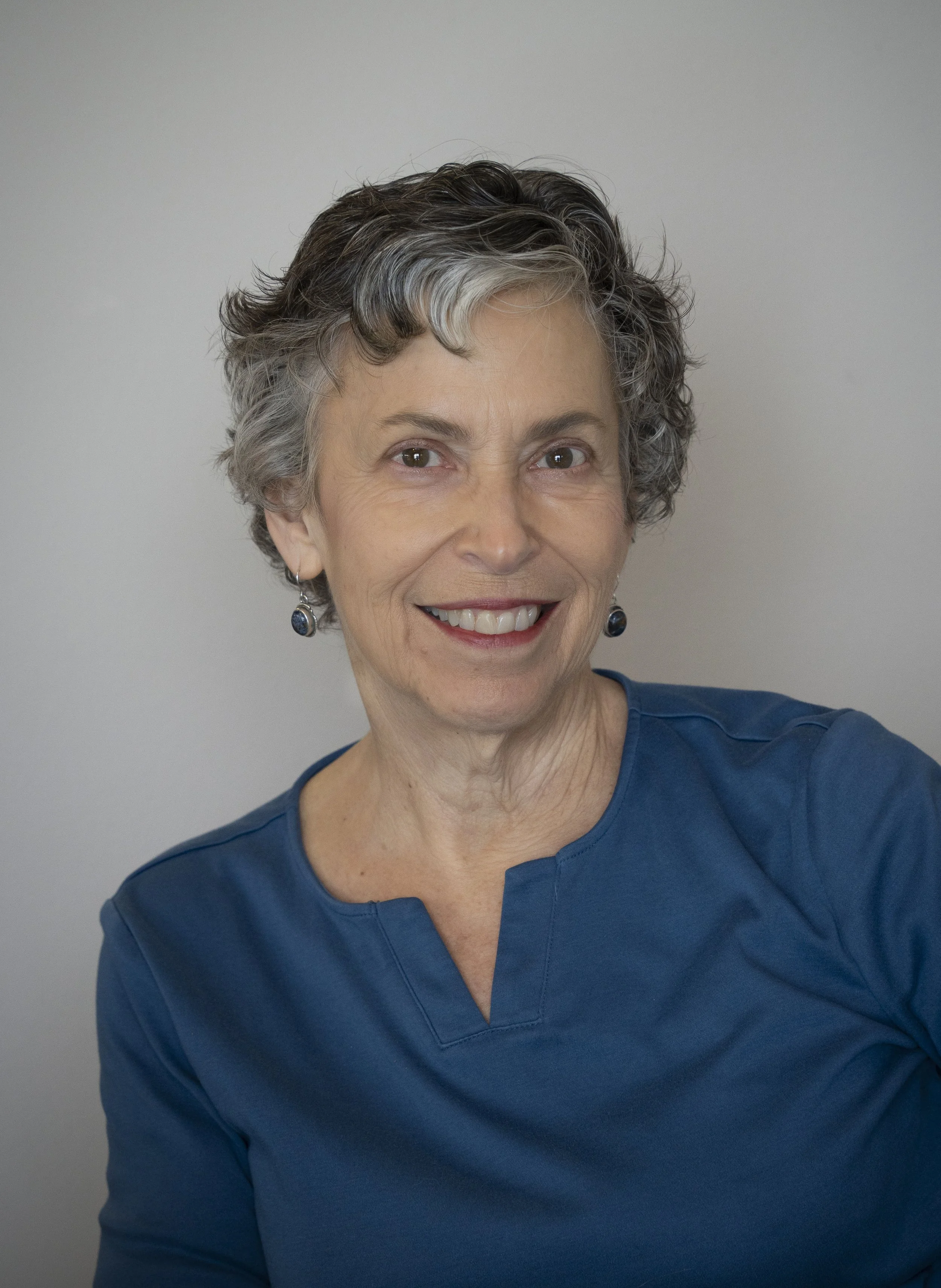
It has been a difficult time for many as of late — we've been witness to recent multiple losses of creative trailblazers, artists, activists and humanitarians. Some of them have been well-known, like Dolly Parton, Gloria Steinem and Cassandra Wilson, who we may have looked up to, learned from, aspired to be like and occasionally, had the chance to know personally, or call a friend. While she was not as easily recognizable to the public as the aforementioned women, Elena Schwolsky was a trailblazer, artist, activist, healer and humanitarian who inspired many and created vehicles for communication and connection. Elena left a deep impression on me.
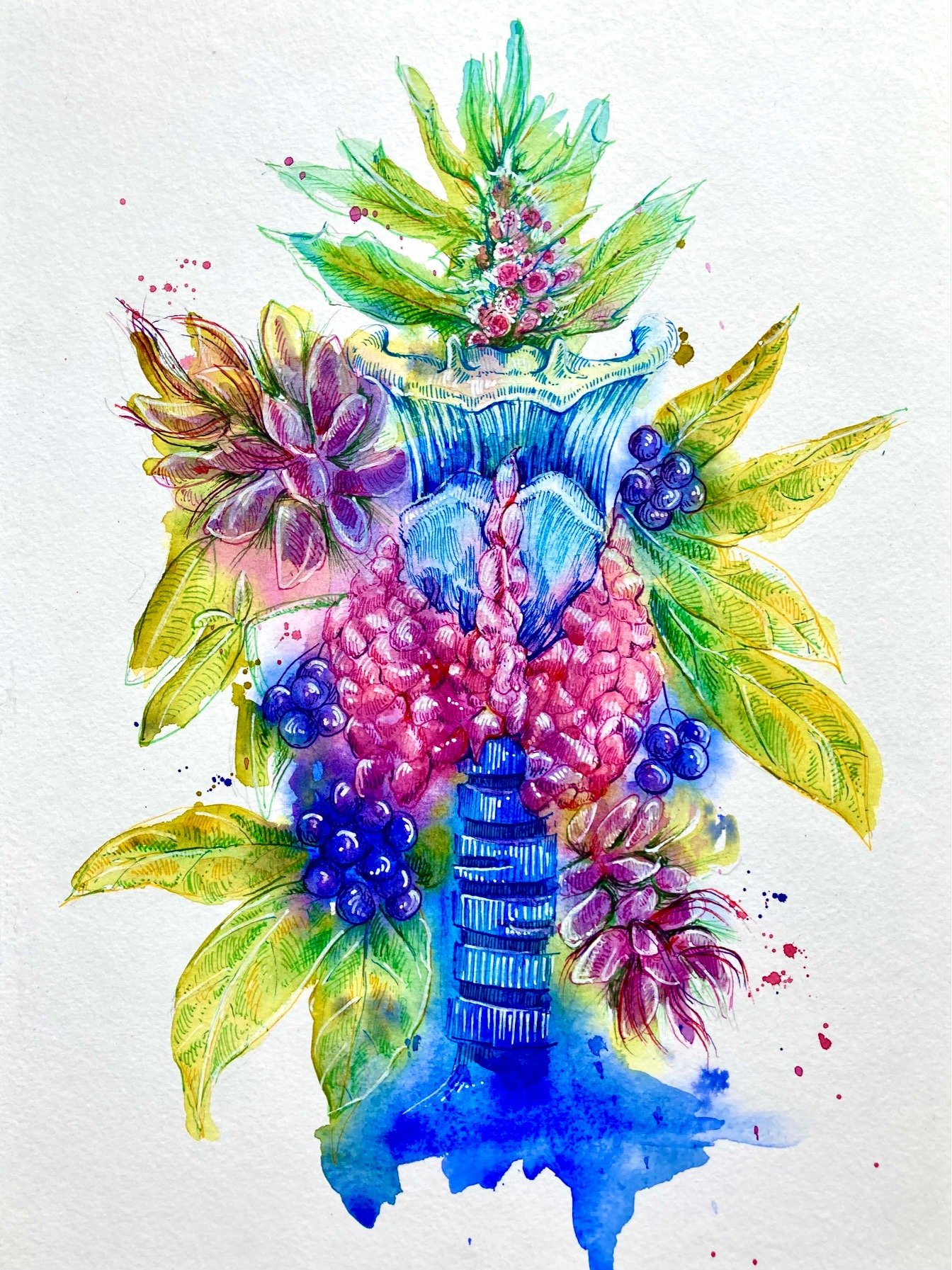
A real thyroid blushes dark pink, surrounded by lighter fascia and dappled with blood, but Sarah Elizabeth Lane’s vivid print “Anatomical Botanicals: Thyroid” (Spring 2022 Intima) transforms the muted tones of internal neck anatomy into a vivid floral bouquet. The trachea, like a striped blue vase, holds up folded red buds of thyroid surrounded by a profusion of berries and leaves. Via email, Lane let me know these plants are açaí and ashwaganda, and that she tries to limit her palette to three colors. Lane’s anatomy-related works push the medical eye to decontextualize the body from an aseptic, gritty, medico-industrial perspective and connect it with the beauty that feeds our souls.

Ellen Chang’s animated short, The Dinner Table (Spring 2026 Intima), beautifully illustrates intergenerational mistranslation, and the difficulty of bridging the divide between first-generation immigrants and their children when it comes to discussions of mental health. As the animation moves between Korean and English, what the daughter intends versus what the father hears, and what the father communicates versus what he means, the dining table at the center of the short lengthens and contracts, the distance between them widening and narrowing as they grapple for understanding.
If the objective is to minimize suffering, yours and mine, as patient and healthcare professional, how do we gesture to each other around the barriers of an imperfect system? Is there any gesture of care too small?

In Mariana Ndrio’s “Chronos: Mind and Heart” (Spring 2025 Intima), crimson and white wires coil together, capturing the intricate relationship between thought and feeling. This symbiosis reminds me of some of the patients who informed my artwork titled “Pericardial Mnemosyne” (Fall 2024 Intima). Patients sometime delay treatment for their metastatic breast cancer because the diagnosis exhumes memories of family or friends who had complex experiences with breast cancer treatment and those who hadn’t survived. Without treatment, however, cancer cells can secret fluid into the sac around the heart – an effusion that swells and stifles the heart from pumping. During hospital stays, the treatment team not only drains the effusion but also opens up the conversation about treating cancer.
In the essay “My Father’s Doctor” (Spring 2016 Intima), Pennsylvania pediatrician Jennifer Chianese purports to write about her father’s relationship with his female doctor and the ways in which that relationship is both rooted in and transcends the traditional roles for women that is his cultural heritage. Her father sees future opportunity for his own daughters in this doctor who would later make headlines by killing her elderly parents. But the secondary story is that of Chianese’s relationship with her father, who became terminally ill when she was just 10 years old, and how she processed through his impending loss. The doctor tells her, “This is a difficult time for your parents. You need to be on your best behavior.”
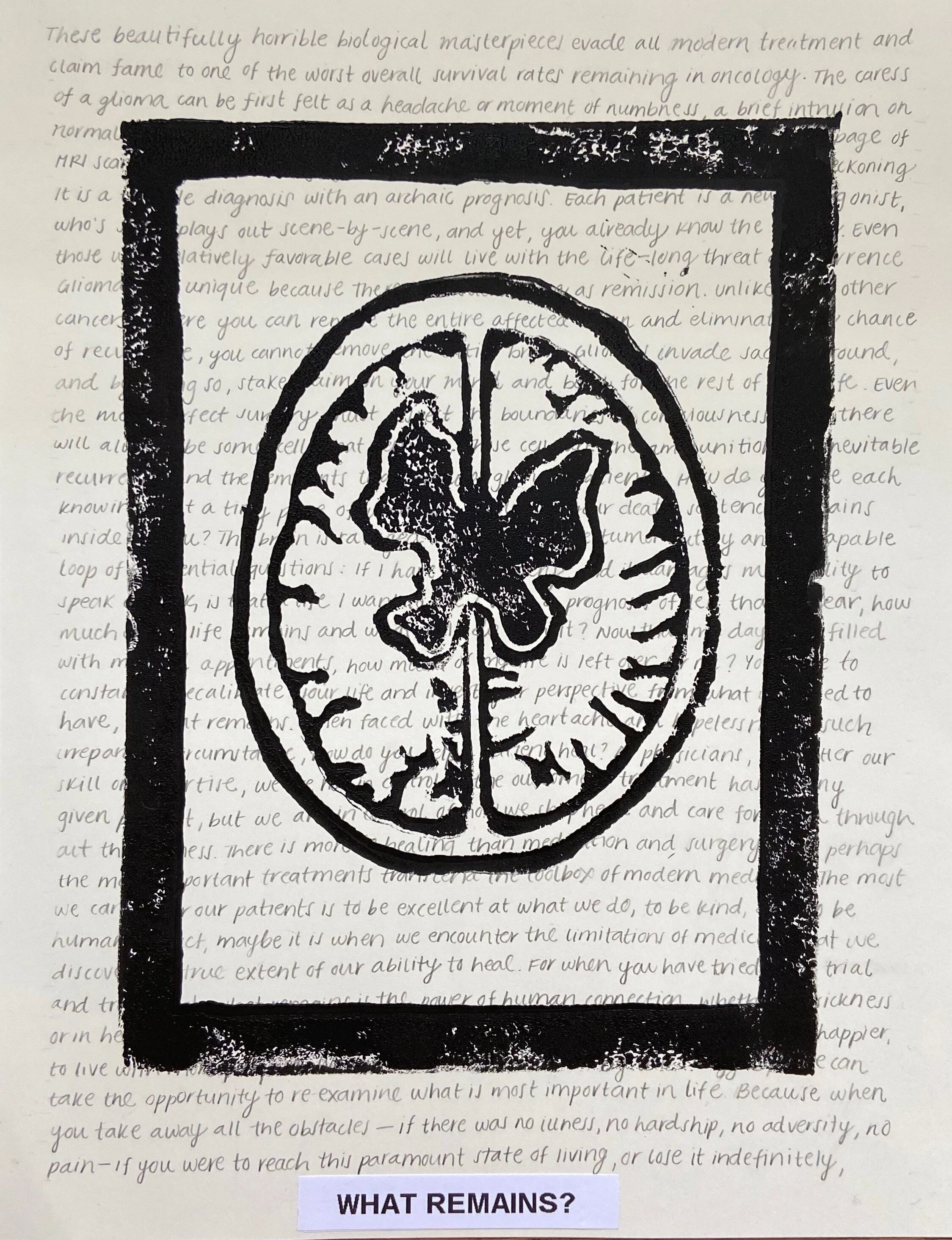
When I first encountered Alexandra Miner’s “What Remains” (Spring 2021 Intima) in the early days of my own glioma diagnosis, I finally exhaled a breath that I’d held deep down. My physicians did care! Despite losing so much function, and my grief over the life I’d built, the questions I spiraled on were valid! There is a priceless comfort in feeling seen in the uncertainty and cruelty of receiving a life-limiting diagnosis as a young(er) adult (YA).
Some voices outlast the people who spoke them. In his Crossroads blog, “The Voice that Lingers,” (June 19, 2026 Intima) Kenneth Iserson, a professor emeritus of emergency medicine, tells it as a physician: the dead mentor keeps speaking in a student's stethoscope, in a resident's patience at two in the morning, even in the margin of a machine's report that has learned to wait before it concludes. The voice refuses to be deleted — not because anyone saved it, but because it had gone in too deep, beneath the skin, beneath the name, where not even death goes looking.

The bunny drew me in first. She is a well-loved stuffie, fur lightly matted even sketched in pencil, form slightly squashed from years of use.
Danica Snyder’s “Memento Mori, Memento Vivere” (Spring 2025 Intima) is in vibrant conversation with my essay “Maybe It’s Beautiful,” which I am pleased to have published here a year later in Spring-Summer 2026. What I love about Snyder’s work is her riotous use of color and pattern and the unresolved ambiguities that lie underneath.

When I first read Joseph Zarconi's poem American Sonnet for an Addict, I thought it was asking many of the same questions that concerned me while writing my essay Re: Interesting Case. Both seemed interested in the uneasy space between a person's experience and the clinical language used to describe it. But I kept returning to the way the poem begins: "The doctor drags his learning flock into my room."