
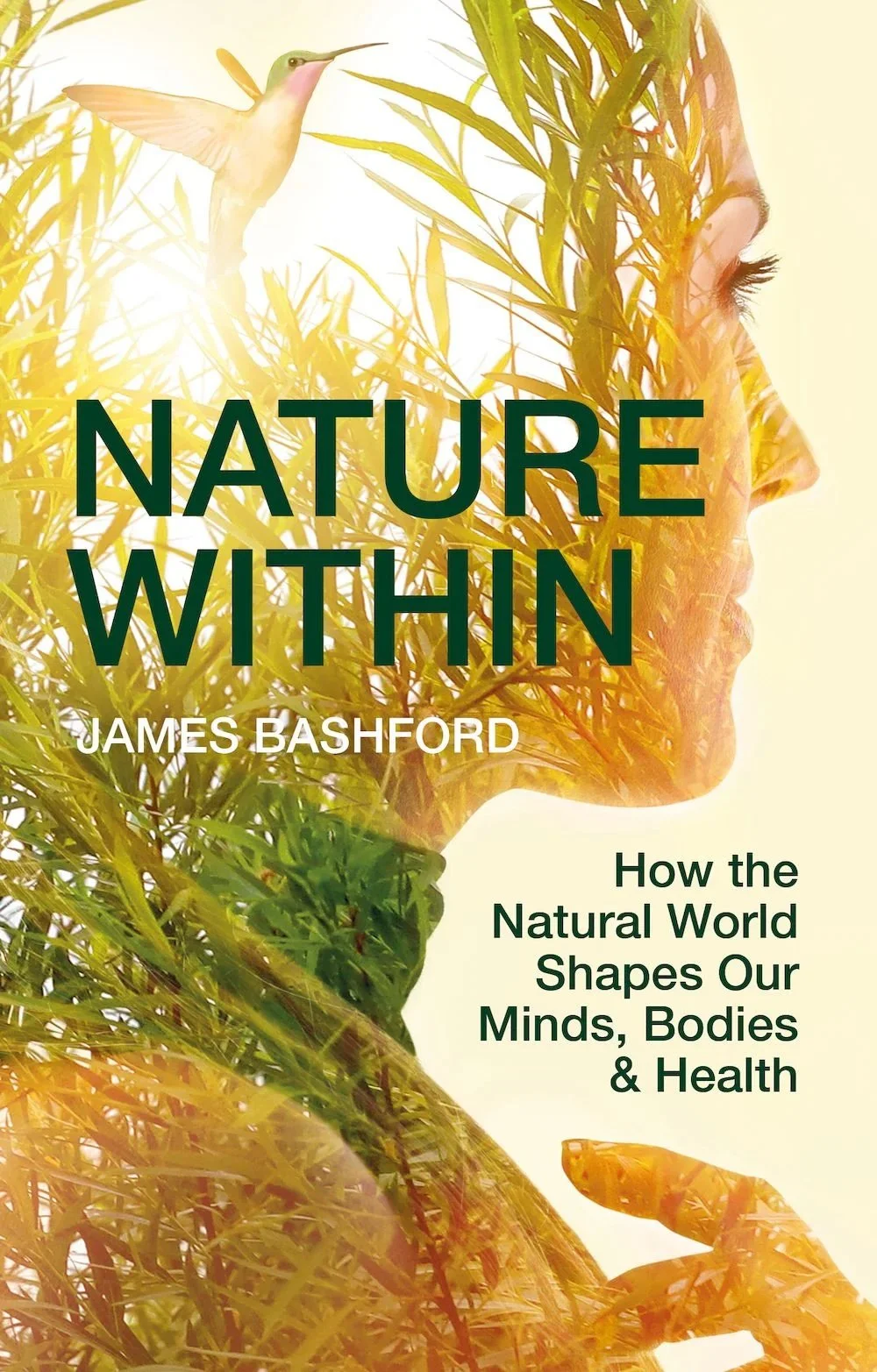
James Bashford’s Nature Within: How the Natural World Shapes Our Minds, Bodies and Health (Pelagic, 2026) is an ambitious, unsettling and quietly demanding book. It carries the force of a moral imperative—but its call to action begins, paradoxically, with mindful attention.
Bashford, who works as a neurologist in South London, stands in the woods listening to a songbird, a Veery. The bird sings what he calls a “harmonic duet”—two notes from one body. Biology and music at once. He pauses, "transfixed."
The scene is more than a lyrical opening; it becomes the book's structural metaphor. Bashford returns again and again to pairings that look like opposites but are not: the resilient and the vulnerable, stability and transition, seed and tree, yin and yang. These are not rival forces. They shape and sustain each other.
The opening is intentional. Bashford, who completed his medical degree at the University of Cambridge in 2010 and obtained a PhD in clinical neuroscience at London's King’s College Hospital in 2019, now leads a research program and care for patients in a specialist motor nerve clinic. He understands the nuances of paying attention and before he makes his argument in Nature Within, he models how to attend to what is around us.
In narrative medicine, we talk about attention, representation and affiliation: the disciplined practice of truly noticing, the work of giving form and meaning to what we observe, and the ethical connection that emerges when we reflect those observations back with care and fidelity.
Nature Within, though rooted in biology and climate science, follows a similar arc. What happens when our attention narrows? When our representations distort? And when our connection to one another—and to the natural world—thins out?
Bashford's central claim is simple but not small: Nature doesn’t just calm us. It forms and shapes us.
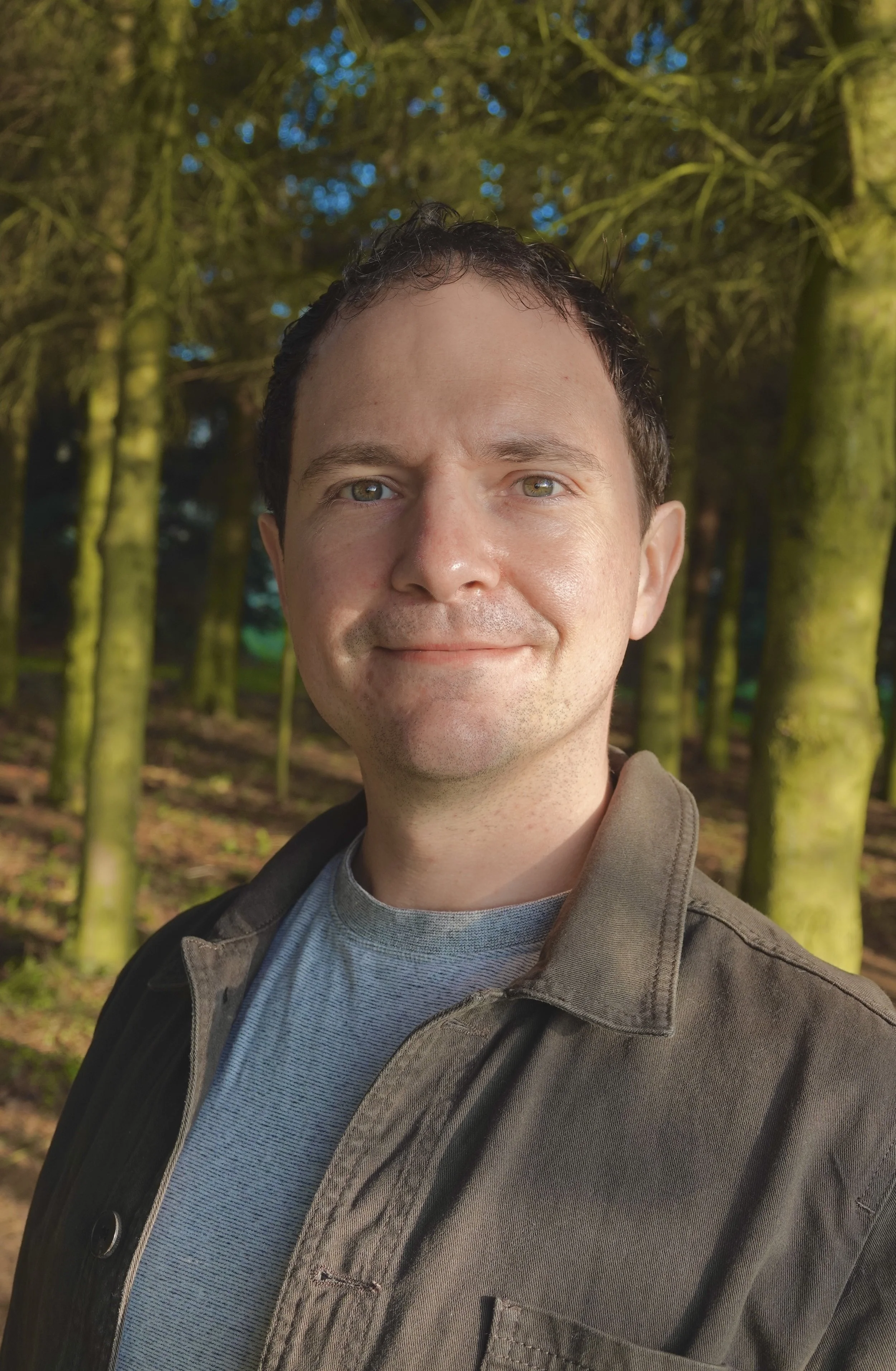
James Bashford completed his medical degree at the University of Cambridge in 2010, before starting specialist neurology training at King’s College Hospital, London. He obtained a PhD in clinical neuroscience in 2019. He now works as a clinical academic and honorary consultant neurologist in South London, leading a research program and caring for patients in a specialist motor nerve clinic. Nature Within is his first book. @wrenandbee.nature
The attention restoration theory posits that exposure to Nature induces something called quiet fascination. This amounts to the satisfaction you experience when you passively let the world pass you by. Instead of directing your attention to a narrow set of tasks, constantly inhibiting the numerous distractions of modern life, quiet fascination allows your brain to expend much less cognitive energy. This gives your brain time to refresh its attentional networks, thereby staving off mental fatigue.
Yet Bashford avoids sentimentality. As a physician redeployed to a COVID ICU, he describes a time when clinical, institutional and existential uncertainty stripped medicine of its usual confidence, making it “by far the scariest period of my short medical career.” Disease, he reminds us, is literally a “loss of ease.” Healthcare lives in that uneasy space between illness itself, the person who suffers and the clinician who intervenes.
Later, he turns that same clinical lens outward. The planet becomes a patient—not with a self-limited fever, but with destabilizing feedback loops. The “climacteric” marks a real turning point in Earth’s health—not normal fluctuation, but rapid, systemic change.
Reading this, I kept thinking about post-pandemic amnesia—the way we move on without digesting what just happened. We normalize instability. We forget how close systems came to collapse. We don't learn from experience. But prevention depends on memory. Bashford’s emphasis on the small "reset" and ongoing recalibration feels like an antidote to that forgetting. Crisis, he reminds us, comes from krisis—decision. What we face is not one catastrophe but an accumulation of choices.
This is where the book's narrative dimension deepens. In a chapter he calls “The Façade of Knowledge,” he explores the danger of “unknown knowns”—the certainty we mistake for understanding. Science, he notes, has no ego; it revises itself. Misinformation spreads differently—like an invasive species—crowding out nuance. Knowledge, in his telling, is ecological. It thrives on skepticism, collaboration and revision. It requires narrative humility—the recognition that we do not see the whole.
The structure of the book mirrors its argument. It begins with encounter, widens into explanation, destabilizes through systems thinking, reframes crisis and returns to walking. In the epilogue, Bashford encounters a shield bug—an indicator species responding to climate shifts. He feels both delight and unease. The naturalist's dilemma. Is this arrival something to celebrate or something to mourn? He walks not to gather data but because walking restores him. And yet in walking, he participates in knowledge.
The book demands a slower pace. Bashford moves across evolutionary biology, immunology, climate science and philosophy. One must pause, reread and hold complexity. The density resists skimming. The reading experience mirrors his argument; just as we decelerate to notice nature, we must slow our thinking to grasp the systems that sustain us.
For those of us working in narrative medicine and institutional life, the parallels are hard to ignore. Burnout, polarization, erosion of trust—these are not isolated problems. They are reinforcing cycles. Exhaustion breeds rigidity. Rigidity fuels division. Division erodes trust. Diminished trust intensifies strain. Bashford’s critique of binary thinking—of identity replacing inquiry—echoes what we see in public discourse. When group loyalty to an ideology overrides curiosity, systems lose flexibility.
In that sense, biodiversity becomes more than an ecological principle; it becomes a social one. Ecosystems thrive on richness and variation. Rare species matter. So do rare voices. Resilience depends on difference, not uniformity.
If there is tension in the book, it lies in the pull between careful explanation and moral invitation. Bashford lays out evidence with precision—gene–environment interactions, immune markers, climate feedback loops—yet he ends with a clear exhortation: "renaturalise your senses on a daily basis." Slow down. Pay attention. Make small, cumulative adjustments. Some readers may resist the shift from analysis to appeal. Yet once systems are seen clearly, the ethical questions follow; now that we see it, what are we going to do?
Bashford doesn’t promise redemption. He reframes responsibility as iterative. Borrowing from solvitur ambulando—it is solved by walking—he suggests that change emerges through sustained recalibration, not grand gestures.
The Veery’s duet lingers: two air streams, one body. Stability and transition intertwined. Science and story. Mechanism and meaning. Planet and person.
The question Nature Within leaves us with is not whether nature is speaking. It is whether we are listening—and whether we will remember what we hear long enough to act. Listening, in the end, may be the first form of care. —Tony Errichetti

Tony Errichetti is a CPA graduate from Columbia’s Narrative Medicine program. He is co-founder of the Simulationist Narrative Medicine Community and Director of the Standardized Patient Program at SUNY Downstate University of Health Sciences, where he leads initiatives in simulation-based education, communication training, and narrative-informed learning. He is also a founding member of Narrative Mindworks, the international narrative practices association.
