This truth became inescapable when I began my nursing career on a cancer and hospice floor. Oncology care is fraught with the observation of suffering. The desire to find meaning in pain converges with the harshness of reality. Why
Calling to Question: A Reflection on Healthcare Providers’ Perceptions of Life and Death by Tharshika Thangarasa
Life and death, as blatantly simple as they may seem from a purely physiological standpoint, are rather complex phenomena. Healthcare practitioners witness life and death a countless number of times. They are taught the intricacies of the human body: how to optimize its function and how to declare it deceased. Yet, nothing can prepare even the masters of this trade to face their own demise.
Read moreDenying Demons: A Meditation on PTSD and Vietnam Veterans by Billie Holladay Skelley
Our verbal and written stories tie us together and promote understanding. They help us to work through traumatic experiences, to acknowledge our demons, and to heal.
Read moreToo Little Skin for These Bones: A Meditation on Poetry and Illness by Sydney Sheltz-Kempf
Illnesses are contagious.
We all know this, but while the frame on the bed grows ever smaller, sometimes the faces of the grieving grow gaunt as well.
Read moreIt’s a Pisser: Considering two sides of kidney disease by Larry Oakner
I first discovered I had Minimal Change Disease, the mildest form of nephrotic syndrome, when a routine insurance urine examination came back with higher than normal protein. Up until then, I assumed that foamy urine was a by-product of what I’d eaten or had to drink. In Sarah Safford’s poem, “A Cute Kidney Failure” from The Intima Fall 2016 issue, she asks the same question, “Kidneys, shmidneys, who thinks about them.” After my initial diagnosis, I did. A lot.
Read moreOn Waiting: A Meditation on Waiting Rooms by Sara Lukinson
No one, not even someone you love, can fill the hollowness. Still you cannot walk this alone. You need a witness, an errand goer, a soft presence, a light in the hallway. Someone who brings you tea or clean clothes, whose eyes will look back into yours.
When I looked up from all the waiting rooms, I found a communion of once-strangers waiting to help me
Read moreWhat Emily Post Has to Teach Us About Cultural Competency in the Clinical Encounter by Olaf Kroneman
What to do?
In 1927, in his lecture to Harvard medical students, the terminally ill Francis Peabody M.D. provided the answer, “the secret in caring for the patient, is in caring for the patient.”
Read moreCreating A Sense of Togetherness by Jake Drobner
Togetherness is not artificial–it is not forced into the nooks and crannies between people. It is intrinsic to our existence as humans, no matter how fleeting the collision of our worlds. Moreover, togetherness need not be physical. We can feel connected to
From Authoritarianism to Mentorship: The Hierarchy in Medicine by Kany Aziz
The hierarchy in medicine is impossible to ignore. Medical students shuffle, interns survive, senior residents manage, and staff attendings command. Fortunately, these relationships have evolved over the last few decades and past feelings of authoritarianism have turned into mentorship.
Read moreThe Diagnosis of Dying by Christopher Adamson
The sociological concept of the “sick role” may absolve patients of responsibility for causing their illness. But it does not protect them from the stigma often associated with illness. Nor does it protect them from their own feelings and thoughts.
Read moreThe Little Ones: Considering what illness looks like from a child’s perspective by Kelley Yuan
The Room by Jodi Paik (Fall 2016) and my artwork The Last Stand both examine medicine through the eyes of a child— a perspective not yet laden with the what-if’s, should-have’s, and if-only’s that come with growing up.
Read moreStorytelling: A Way to Gain Perspective on Past Traumas by Cheryl Shore, ARNP
When something dramatic, threatening, and life-altering happens, chaos frequently ensues among those affected. While individuals struggle to incorporate the trauma into their lives, the relationships among them are inevitably strained.
Read moreFormaldehyde and Gratitude by Sarah Shirley
In her poem “Letter to a 93-year-old Cadaver Who Died from Multiple Causes,” published in the Spring 2014 Intima, I feel Jennifer Stella perfectly presents the learning curve of a medical student working with their first human patient – a body gifted to them to dismantle.
Read moreThe Lessons Clinicians Can Learn From ‘Neglected Disease’ by Carol Scott Conner, MD
We, as physicians should go beyond “Why do they do this?” to ask, “Where did trust break down?” and, “How may I make myself a worthy recipient of my patient’s deepest, darkest fears?”
Read moreMemory, The Most Mysterious Faculty: A Reflection on Austen, Alzheimer’s and “Aberrant Decoding” by Carlene Kucharczyk, MFA
Memory may seem even more mysterious when there’s less of it—why do we remember this and not that? Other times, it seems to make perfect sense, especially with Alzheimer’s patients, who often remember earlier memories and forget later ones.
Read moreCultural Competency as a Rite of Passage By Rose Jones, Ph.D.
Transitioning from a cross-cultural neophyte into a culturally competent warrior is a precarious and arduous process in medicine. It is typically a journey accomplished on one’s own with little guidance, training or support. It’s also a journey that requires deep self-reflection and the ability to objectively critique the culture of biomedicine.
Read moreOpenness vs. Secrecy: What happens when we share our illness story? By Meredith O’Brien
Openness vs secrecy. These subjects are familiar to anyone who has ever struggled with a serious health condition.
Read moreLetter to a Caretaker: An Acknowledgement by Jutta Braun, RN
Dear Caretaker:
As I read, I felt with you the fear, the pain, the madness.
The would-be caretakers – police, EMT’s, nurses, doctors – all too human and apathetic. Aren’t we all? I, too, am angry with them – for taking your dignity, and giving nothing in return.
Read moreIn Defense of Others: A Reflection About the Ways Illness Can Divide and Conquer Concern by Liz Fyne. MS
Her first night on call she is assigned the care of a man with AIDS. He is rail thin, on the slow train to death. He was once a person just like her, but now he seems frightening, repulsive, and dangerous, although endlessly pitiful.
Read moreDinner, Revelations and Narrative Medicine: Tales told by Intima Spring 2017 by poet Wendy French
This is a blog about Intima and narrative medicine in general and all that we can read and absorb from this excellent online journal. Every issue grabs my attention for the poetry, articles and the blogs that respond to other people’s work.
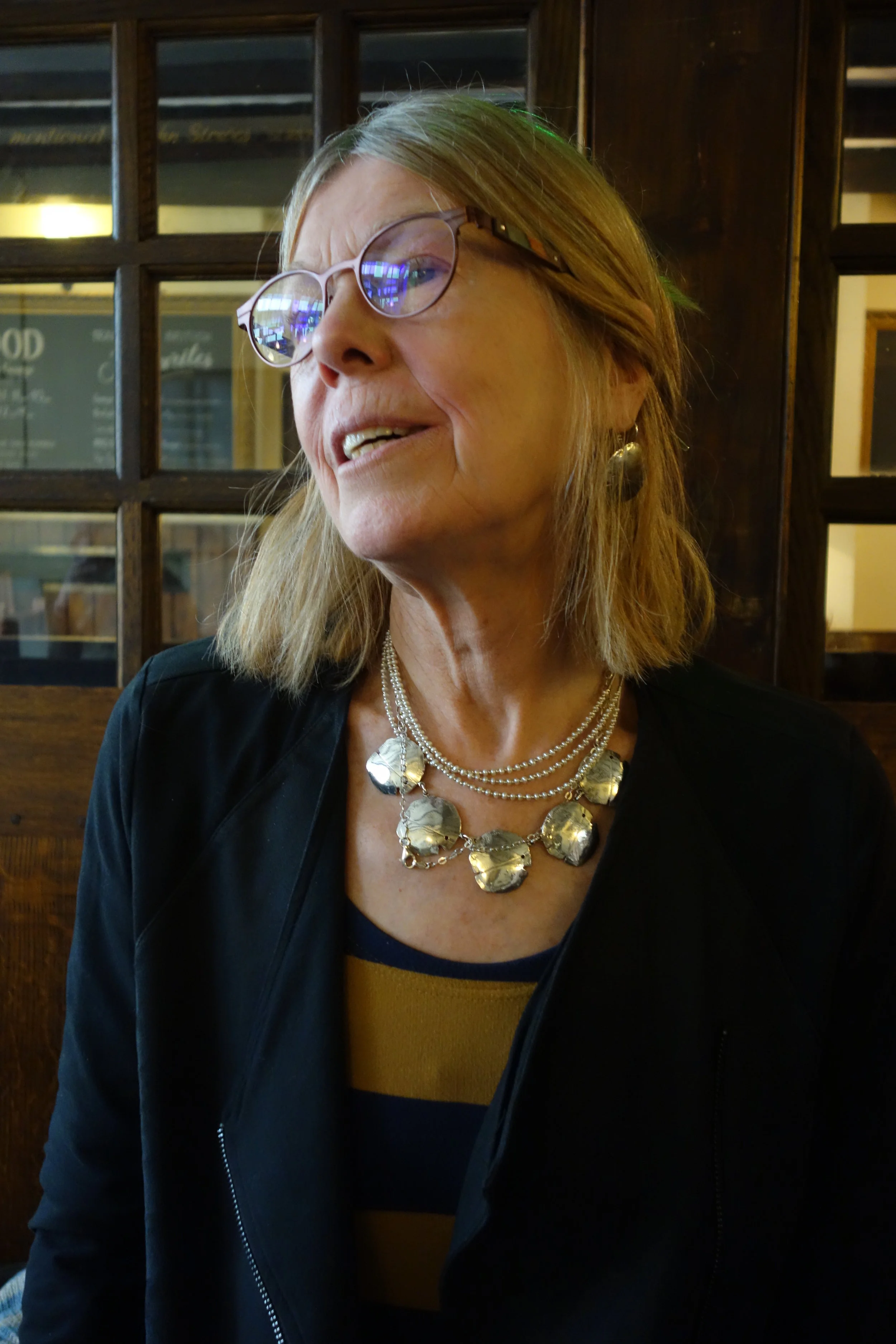
Wendy French is a poet, whose latest collection of poems is "Thinks Itself A Hawk" (Hippocrates, 2016). Her collaboration with Jane Kirwan resulted in the book "Born in the NHS" (Hippocrates, 2013). She won the Hippocrates Poetry and Medicine prize for the NHS section in 2010 and was awarded second prize in 2011. She has worked for the past twenty years in healthcare settings. Her poem "Exchange" appears in the Spring 2017 Intima.
My poem "Exchange" was written after my son came home from working in the Far East. He brought with him a girlfriend who had also been working with him for the British Council. Poom was Thai. We had never met before and they arrived in the evening. She was exhausted from the long flight. I had prepared a meal and over supper, a nurturing and nourishing time and good time to talk with new and old friends. She told me that her father had died and she was still very sad. We had candles on the table but we lit another one for her father and placed it in an important position near the flowers that seem to symbolize new growth, new seasons.
Then Poom started to tell us that she had had Stevens-Johnson Syndrome, a syndrome I had never heard of. But as she told us her story another narrative emerged, the emotional need to now pass on the story. This for me is what narrative medicine is all about. It’s telling our stories to a health professional who can understand what is going on for us emotionally, intellectually and physically. Poom felt, at this supper in a country she didn’t know, not long after her father’s death and this dreadful illness, that she needed to talk about it and try and rid the experience from her mind in a strange country. This was her narrative being told right now.
I was very struck by the wisdom in Vivian Lam’s Crossroad's essay "This Game We Play Called Dying." Even dying has a narrative for each individual although by the time we are in the clutches of death we may be too ill, too sick, to tell our story to anyone. So it is the people who care for us who have to interpret our story at this stage of our lives. Hence the need, as Vivian Lam says, to be able to know whether or not the dying person wants someone with him/her now or whether she/he’d rather take the final steps alone. Therefore it is the responsibility (and I mean responsibility) of the nearest person to the dying to have found out this part of the narrative while it is possible to do so. This may be the health professional who cares and treats the dying with compassion. Dying is the final and may be the most important part of the narrative.
Wendy French is a poet, whose latest collection of poems is Thinks Itself A Hawk (Hippocrates, 2016). Her collaboration with Jane Kirwan resulted in the book Born in the NHS (Hippocrates, 2013). She won the Hippocrates Poetry and Medicine prize for the NHS section in 2010 and was awarded second prize in 2011. She has worked for the past twenty years in healthcare settings. She was Poet in Residence at the UCH Macmillan Centre from April 2015-2016 and this year will be working with patients/caregivers on writing memoirs. She is one of six poets invited to Bucharest to work with MA students on translations of their novels into English. She currently is writing poems to celebrate Waterloo Bridge.