
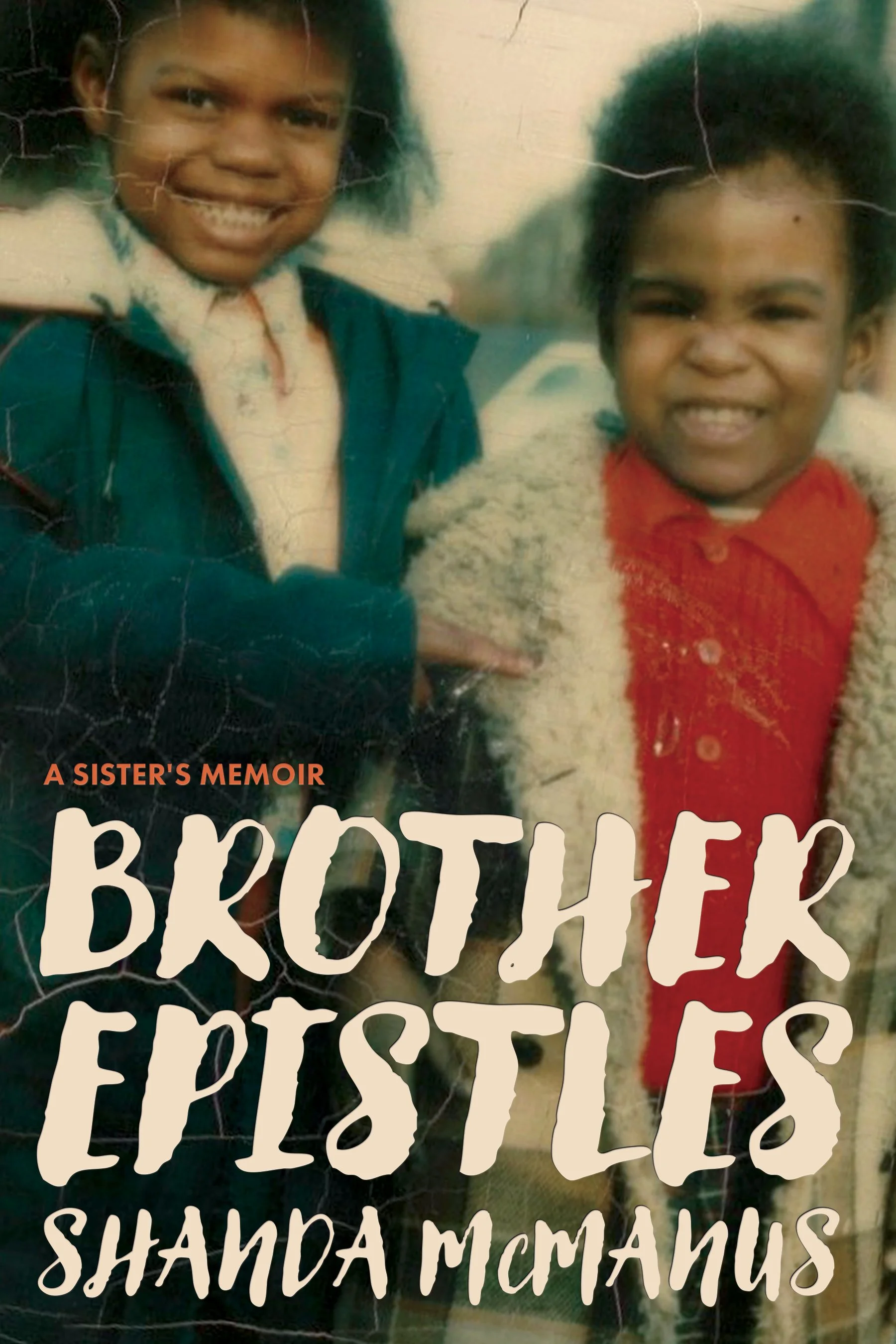
What does it mean to keep speaking to someone who can no longer hear you? Brother Epistles: A Sister's Memoir (Split/Lip, 2026) does just that. At its core, the epistolary book is an extended address from physician Shanda McManus writing to her brother, Monir, who was killed in a drive-by shooting in Philadelphia in 1992. He was 20 years old.
What unfolds is a memoir of grief, race, memory, family history and survival but also something more structurally intimate: a sustained act of speaking across absence. Each section begins the same way, in cursive—Dear Monir—a visual and textual return that reinforces the ongoing nature of the relationship. The form itself refuses finality.
The choice to frame this work as an epistle is not incidental. An epistle assumes a recipient. It presumes relationship, distance, and the persistence of connection across that distance. And as a memoir, it grounds McManus in her lived experience, giving it weight, context and emotional force. It allows her to continue speaking to her brother rather than speaking about him. We, as readers, are intended witnesses, a private story shared.

Shanda McManus, born and raised in Philadelphia, earned her BA in English from the University of Pennsylvania and her MD from Thomas Jefferson Medical College. Her writing has appeared in Intima: A Journal of Narrative Medicine, Midnight & Indigo, Bellevue Literary Review, and swamp pink. In 2021, McManus was named a PEN America Emerging Voices fellow in creative nonfiction, and in 2023, she was a fellow at Baldwin for the Arts. McManus has practiced family medicine for over 20 years and is an assistant professor of clinical medicine at Hackensack Meridian School of Medicine, where she teaches narrative medicine. Her powerful essay “Learning to be Real” about the mind-spinning interaction between motherhood and medical training appeared in the Fall 2019 Intima.
Author photo by Sue Barr
From the opening, McManus unsettles the idea that memory can stabilize anything. Memory, she writes, is filled with "holes and empty spaces," signaling that what follows is not a fixed account but a reconstruction shaped by grief.
Time does not progress cleanly. Monir's death does not sit in the past; it recurs. At one point, she reflects that "time may be a loop," a formulation that captures both the narrative's structure and its emotional reality.
At the center of the book is a question that is never reconciled: how to hold responsibility without control. The narrator's self-address—"Do you blame me? It's ok, because I blame myself." —does not function as confession or absolution. It functions as structure. It organizes the narrative without resolving it. The speaker becomes both witness and accused.
Brother Epistles resists a story of conventional grief. There is no movement towards acceptance of loss. Instead, grief is recursive. It accumulates. Earlier losses were communal, held within a shared feeling of mourning. Monir's death fractures that field.
"There was no one who lost exactly what I had: their brother Monir Hall." she writes, marking the shift from collective grief to singular, untranslatable loss. Others are present, but they cannot fully inhabit the same loss. The narrative holds that tension without trying to repair it.
As the book widens, it becomes clear this is not only a story of personal grief. It is a study in how environments—social, linguistic and physical—shape what can be felt and what must be endured. Language, in particular, is never neutral here. A childhood encounter with a racial slur is described as something that "slapped me in my face," translating language into embodied force. Words do not simply describe reality; they act within it. They assign, divide and mark. The narrator describes the paradox of linguistic reclamation—how the "N-word" can be both internal to a community and still carry the force of its original violence. The contradiction is not resolved. It is something to be borne rather than fixed. Instead it mirrors the book's central tension: how do you hold something that both belongs to you and exceeds your control?
Space functions similarly. Green spaces—porches, parks, beaches—are described with sensory precision. When pulling into her driveway she notes. "I feel my blood pressure go down," a physiological response that contrasts sharply with the tensions of urban life. Yet these spaces are not universally available. The question—"Why do some people get grass and others cracked concrete?" —reframes environment as structure rather than backdrop.
This is where the narrative's social dimension in Brother Epistles sharpens. Monir's death is not treated as an isolated event. It is situated within a network of systemic forces. McManus references a historic 1985 incident when Philadelphia police dropped a bomb on the home of the Black liberation group MOVE, resulting in the death of 11 people and the destruction of a city block. The bombing fits into the narrative of Brother Epistles as a powerful historical parallel to the author's personal loss, situating individual grief within the larger story of collective suffering and resilience.
As McManus, who was a 2023 Baldwin for the Arts fellow and 2021 PEN America Emerging Voices fellow, moves into a different socioeconomic space, another tension emerges: dislocation. Becoming an MD deepens her sense of being caught in "the space between the two," no longer fully belonging to her community of origin, yet never entirely at ease in her new environment. Her success as a doctor does not resolve her past; it complicates her identity, relationships and sense of belonging.
This in-between state becomes the book's central condition. It is not transitional. It does not lead somewhere else. It is where she lives—and where the letters return.
In that sense, the epistolary form does more than structure the narrative—it sustains it. Each Dear Monir reactivates the relationship. Each address refuses finality. The writing becomes a site of ongoing contact, where absence is acknowledged but not allowed to close the conversation.
The memoir moves from personal grief to a broader meditation on legacy, asking what is inherited across generations—not just through explicit stories, but also through what is left unsaid and the repeated patterns of behavior, trauma and survival. McManus asks:
"What did we inherit from him that we don’t even know about? Did we get survival genes or resilience genes? Like the superhuman power of suffering without disintegrating? What doesn’t kill you makes you stronger shit. I don’t know, but I would like to think you get some good out of loss."
What the book ultimately resists is resolution. Even in its closing moments, as the narrator begins to shape her experience, clarity does not become resolution. The line "I chose life" carries a quiet tension—both declaration and concession, less an ending than a way of going on.
Writing itself becomes that way forward. In lyrical, precise and deeply-felt prose, McManus provides an original angle to the epistolary form. The epistle is not closure but upkeep, a practice of keeping the relationship alive despite the absence of reply. In the end, the book turns on what it means to live alongside what cannot be repaired. It offers no redemption, no clean synthesis. It holds contradiction in place.
In Brother Epistles, McManus’s sibling Monir remains, not as a settled memory, but as presence sustained through address. The narrative becomes the space where that connection persists, where loss is neither undone nor concluded, but carried forward, letter by letter.—Tony Errichetti
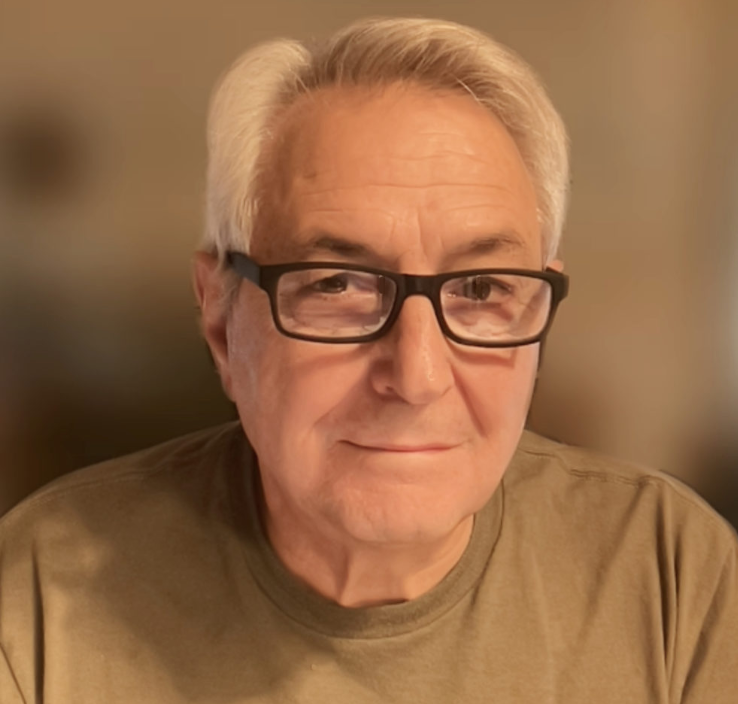
Tony Errichetti
Tony Errichetti is professor and director of the standardized patient program at SUNY Downstate Health Sciences University and founding member and director of programming for Narrative Mindworks. He is an instructor at Pace University in New York City, where he teaches medical English and communication skills to international medical graduates through the English Language Institute. He is graduate of Columbia University’s Narrative Medicine program, where he earned a certificate of professional achievement in 2021. He has presented nationally and internationally on patient simulation, communication and empathy assessment, group facilitation and narrative practices in healthcare education
