
On Bodies and Minds: A Reflection on Raina Greifer’s Artwork 'Bodies' by Diane Forman

Raina Greifer’s artwork “Bodies” (Spring 2018 Intima) compels viewers to confront their own preconceptions and biases about body form. Her three headless, faceless bodies, of various sizes and depths, present a seemingly endless network of intertwined organs and bones, of breastplates and intestines and veins. Greifer urges the viewer to consider vulnerability, in the context of these drawings.
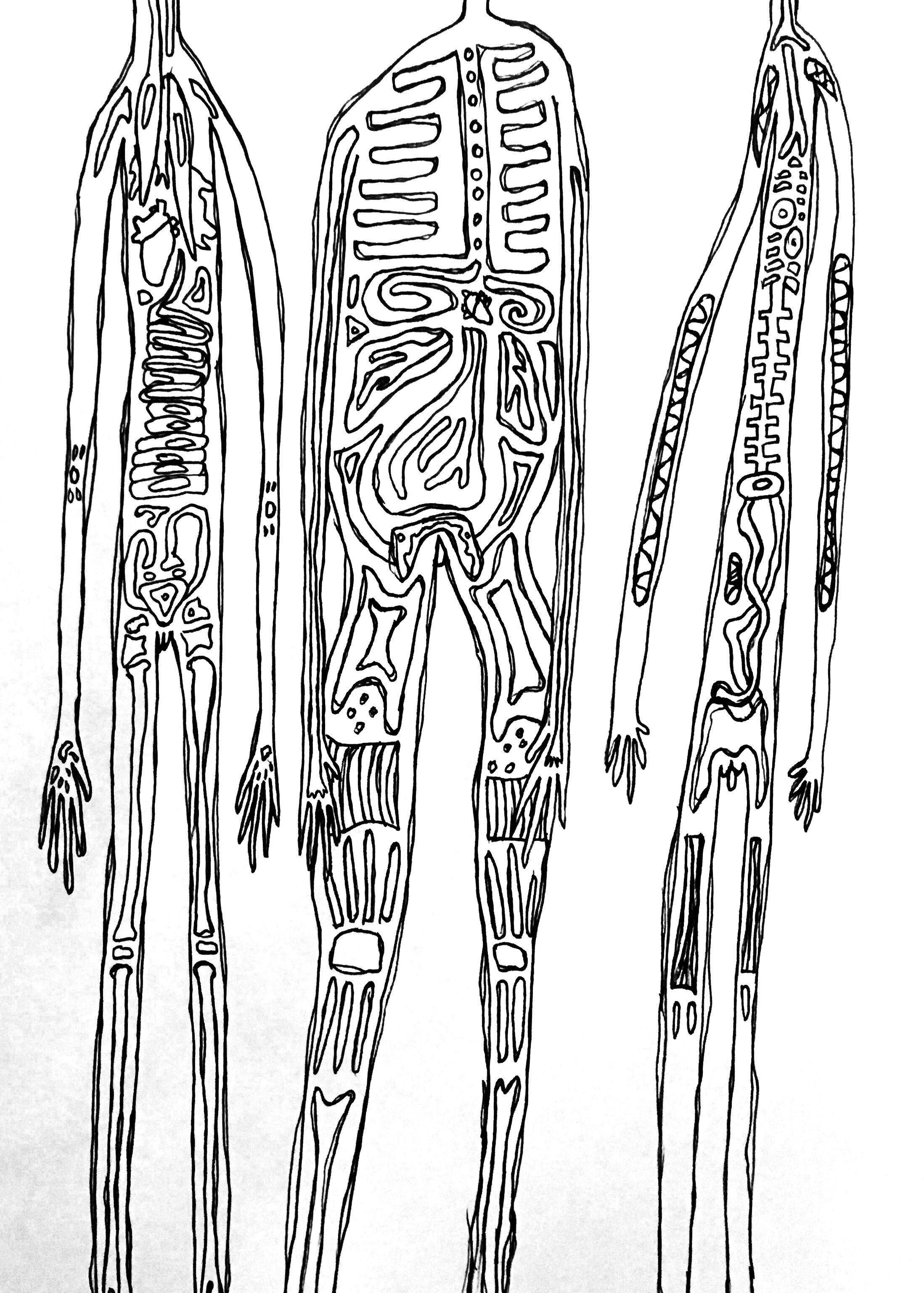

©Bodies by Raina Greifer. Spring 2018 Intima

©Bodies by Raina Greifer. Spring 2018 Intima

Of course the body is much more than a composite of bones and organs, but a human cannot survive without the exquisite interplay of these parts. Greifer’s drawing asks me to consider not only the body’s intricate internal structure, but the external form shown to the world. Although the drawings are deliberately missing heads, the artist highlights the theme of vulnerability, which can only be contemplated through the integral component of the mind. Our minds magnify our vulnerability; our thoughts determine how we visualize ourselves, how we feel in our own skin.


After a lifetime of my own struggle with body dysmorphia, I was forced to confront both the mind and body’s strength and fragility when dealing with my daughter’s restrictive eating disorder, explored in my piece “Holding my Breath” (Spring 2020 Intima). Helplessly, I witnessed the ways in which the body fails without sufficient nutrition; how the body is reduced to conserving energy for the heart, brain, muscles, digestion. The body truly becomes a vessel of organs and bones all vying to survive.

But the starved mind is trying to survive too. Recovery is dependent on replenishing not only the organs with required energy, but the mind with recognition of the body's miracle and potential, whatever its size. I value Raina Greifer’s artwork, which encourages me to consider the vulnerability of the mind, and its intimate connection with the complexity of the body.


Forman, Diane.jpg

Diane Forman is a writer and educator. After a long career as writing tutor and educational consultant, Forman is currently working on a series of essays and a memoir. Additionally, she leads adult writing groups and retreats on the north shore of Boston. She holds a BS in English and Education from Northwestern University, and an Ed.M. from the Harvard Graduate School of Education and is an AWA affiliate, trained and certified to lead workshops in the AWA (Amherst Artists and Writers) method. Her non-fiction essay “Holding My Breath” appeared in the Spring 2020 Intima: A Journal of Narrative Medicine.

Dads, Daughters, Death by Pat Arnow

Pat Arnow is a photographer, writer, and more lately, a cartoonist in New York. She often writes and draws stories about death.Her artwork “A Death in Chicago, 1972: Elisabeth Kübler-Ross and My Family” appears in the Spring 2019 Intima: A Journal o…

Pat Arnow is a photographer, writer, and more lately, a cartoonist in New York. She often writes and draws stories about death.Her artwork “A Death in Chicago, 1972: Elisabeth Kübler-Ross and My Family” appears in the Spring 2019 Intima: A Journal of Narrative Medicine.

A dad has cancer. He decides not to undergo a risky, possibly ineffective operation that might save him. His family supports his decision. He goes home to die.

Karen Dukess writes about this in “Day One of Dying” (Fall 2016) as if those choices were an everyday thing.

Well they are—now.

In this lovely memoir of a beloved father, it is striking to me how things have changed from when my dad faced terminal cancer in the early 1970s. Then the rule was maximum intervention no matter what the prognosis. No one would quibble with doctors. People died in hospitals.

That’s how the story begins in my comic, “A Death in Chicago, 1972: Elisabeth Kübler-Ross and My Family” (Spring 2019). As my father lay dying in a hospital bed, he received a remarkable visit from Kübler-Ross, who had recently written On Death and Dying. She allowed my dad to say out loud how he wanted to stop painful treatments and go home to die.

My father’s homecoming came on the cusp of change for the dying and for those close to them. We started talking about death. The hospice movement grew. There is help for what are still the hard and sad days of dying.

Yet so much is the same including the moments of grace. I recognized this lesson, a gift from our dads as Dukess describes it:

“Day 6 of Dying—I am becoming a better listener. Really, what can you say?”


Pat Arnow is a photographer, writer, and more lately, a cartoonist in New York. She often writes and draws stories about death.With “A Death in Chicago, 1972,” she tells the story of her father’s dying, which involved Elisabeth Kübler-Ross, because it’s a personal story from a time of momentous change in the way we think about death.  Her artwork “A Death in Chicago, 1972: Elisabeth Kübler-Ross and My Family” appears in the Spring 2019 Intima: A Journal of Narrative Medicine.

© 2019 Intima: A Journal of Narrative Medicine