
Ellen Chang’s animated short, The Dinner Table (Spring 2026 Intima), beautifully illustrates intergenerational mistranslation, and the difficulty of bridging the divide between first-generation immigrants and their children when it comes to discussions of mental health. As the animation moves between Korean and English, what the daughter intends versus what the father hears, and what the father communicates versus what he means, the dining table at the center of the short lengthens and contracts, the distance between them widening and narrowing as they grapple for understanding.
Read moreA Reflection on Fathers and Daughters by Dixie L. King
In the essay “My Father’s Doctor” (Spring 2016 Intima), Pennsylvania pediatrician Jennifer Chianese purports to write about her father’s relationship with his female doctor and the ways in which that relationship is both rooted in and transcends the traditional roles for women that is his cultural heritage. Her father sees future opportunity for his own daughters in this doctor who would later make headlines by killing her elderly parents. But the secondary story is that of Chianese’s relationship with her father, who became terminally ill when she was just 10 years old, and how she processed through his impending loss. The doctor tells her, “This is a difficult time for your parents. You need to be on your best behavior.”
Read moreLearning How to Live While Knowing the Ending by Katerina Obscura
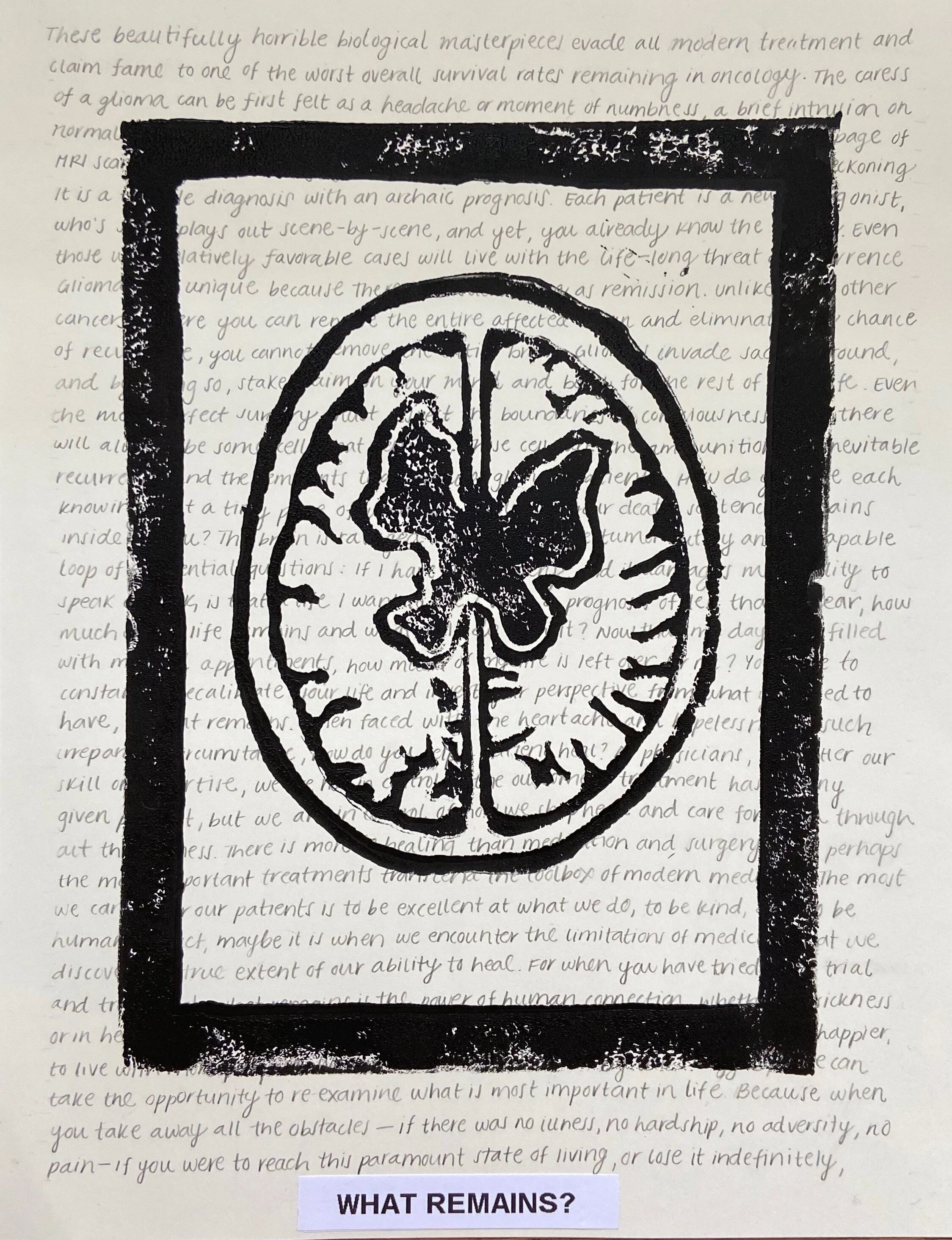
© What Remains. Alexandra Miner. Spring 2021 Intima: A Journal of Narrative Medicine
When I first encountered Alexandra Miner’s “What Remains” (Spring 2021 Intima) in the early days of my own glioma diagnosis, I finally exhaled a breath that I’d held deep down. My physicians did care! Despite losing so much function, and my grief over the life I’d built, the questions I spiraled on were valid! There is a priceless comfort in feeling seen in the uncertainty and cruelty of receiving a life-limiting diagnosis as a young(er) adult (YA).
Read moreVoices That Remain: A dialogue about mentors, memory and what matters
Some voices outlast the people who spoke them. In his Crossroads blog, “The Voice that Lingers,” (June 19, 2026 Intima) Kenneth Iserson, a professor emeritus of emergency medicine, tells it as a physician: the dead mentor keeps speaking in a student's stethoscope, in a resident's patience at two in the morning, even in the margin of a machine's report that has learned to wait before it concludes. The voice refuses to be deleted — not because anyone saved it, but because it had gone in too deep, beneath the skin, beneath the name, where not even death goes looking.
Read moreA Bunny, Beauty and Remembering to Live: A reflection by narrative medicine practitioner Alexis Rehrmann

© Memento Mori Danica Snyder Spring 2025 Intima
The bunny drew me in first. She is a well-loved stuffie, fur lightly matted even sketched in pencil, form slightly squashed from years of use.
Danica Snyder’s “Memento Mori, Memento Vivere” (Spring 2025 Intima) is in vibrant conversation with my essay “Maybe It’s Beautiful,” which I am pleased to have published here a year later in Spring-Summer 2026. What I love about Snyder’s work is her riotous use of color and pattern and the unresolved ambiguities that lie underneath.
The Body Holds It All: Love, Labor, and the Weight of Care by Mildred Galvez
With the same hands that now hold and annotate my textbooks, I once read and reread my mother’s biopsy results. With those same hands, I helped her rise from her chair when the chemotherapy was too strong, and with those same hands, I now care for my patients.
Read moreLiving Alongside Loss: A reflection on grief, rituals, and gratitude by Diego R. Hijano

© Womb by Johanna Glaser. Acrylic paints, linocut prints, tissue paper and pens.
“I made this collage as a gift for a pregnant friend using a mixture of acrylic paints, linocut prints, tissue paper and pens. It is inspired by and directly draws upon elements from a portrait of a young dead woman by Egon Schiele. At the time, I was in the middle of a palliative care fellowship and personally recovering from a severe IBD flare. It is a meditation on birth, illness, joy, pain and death; an expression of awe as to how humans can simultaneously be wounded, age, heal, celebrate and create throughout the seasons of our lives.”
Johanna Glaser’s collage “Womb” (Fall-Winter 2025-26 Intima) challenges the idea that life unfolds in emotional stages. Instead, it holds simultaneity:
Birth beside illness.
Joy beside grief.
Healing beside wounding.
Presence beside absence.
That duality emerges in writer and educator Valk Fisher’s Field Notes essay “Diary of a Plunge Year” (Spring-Summer 2025 Intima) and my short story “The Other Son” (Spring-Summer 2026 Intima). Both explore how rituals, whether running beside the ocean or gathering around a table, allow people to live alongside loss without being entirely consumed by it.
Read moreThe Evolution of Anecdote to Story and Beyond by Angus Woodward
My father was a raconteur, and as his dementia advanced, he often got caught in anecdotal loops. In the middle of a familiar story, he would forget that he had told the beginning, repeat it, then charge through the middle before backtracking again, cycling through the tale until some kind of interruption saved him and his listeners.
Reading Samantha Stewart’s poem “Stingray” (Spring 2022 Intima) made me think about how experiences can become anecdotes, which may turn into stories, which may evolve into legends. And I saw how personal legends connect the dying to the living.
Read moreWhere Fear About Living and Dying is Held: A reflection by UC San Diego internal medicine resident Tulsi Patel
When I read the Field Notes essay “Letter to My Oncologist” (Fall 2025 Intima), I was struck by how the writer, psychologist Julia Dobner-Pereira, watches her physician for the smallest fracture of a moment in composure—and how the physician watches her for the same. Their exchanges sit on a narrow ledge—two people trying to hold each other’s fear without admitting how much weight they’re carrying. I recognized that terrain immediately. As a clinician, I’ve felt patients monitor my breathing, my pauses, my half-smiles.
Read moreThe Discordant Note of the Estranged Daughter from California. A reflection about medically-assisted death by Amanda Le Rougetel
The “estranged daughter from California” is an expression used by MAiD practitioners to describe that relative who shows up to rail against the dying person’s wishes to end their life.
Read moreGetting to Say Goodbye: A reflection by patient advocate Holly Cantley
“There is bravery in enduring. There is bravery in leaving.”
Read moreThe Strange Experience of Learning the Art of Medicine by chaplain Elizabeth Ryder
Essayist and chaplain Elizabeth Ryder, author of “String of Pearls” in the Fall 2024 issue of Intima, reflects on an essay by Anna Dovre entitled “Body of Work,” written by family medicine resident Dr. Dovre.
Read moreGiving Up Metaphors: A reflection about how we talk about illness by poet physician Ronald Lands
In both the literary world and in the clinical world, metaphors take hold of our relationship to illness and health.
“Giving Up the Fight,” by Rebeca Stanfel (Spring 2023 Intima) is a first-person account of her struggle with sarcoidosis and the metaphors that complicated her ability to deal with it. Well-meaning friends and family assailed her with encouragement that depicted chronic illness as a battle to be won or lost.
Read moreWitnessing Grief by pediatric hospitalist Sophia Gauthier
Grief walks in many forms, and its footsteps are padded and quiet, imperceptible even, except to those who lay awake at night, counting its tip taps on the upper floor.
Read moreThe Unexpected Labor of Caregiving by Ann E. Green
The poem titled, “To the Woman at My Mother’s Funeral Who Thought It Was So Lovely that My Mother Died at Home” by Kathryn Paul (Spring 2022 Intima, Poetry), circles around my mind days after reading it. Paul’s poem eloquently speaks back to the assumption that it is always good to die at home, that home deaths are always peaceful. The literal hands-on work of caregiving—the cleaning of blood, mucus, urine and feces — is unspoken and generally done by women, whether paid or unpaid, and the writer, who in her bio calls herself “a survivor of many things” captures this in her poem.
Read moreLearning to be Present for an Act of Dying by UCSF Medical Center professor Krishna Chaganti
It is the great privilege of medicine that we are asked to show up, constantly, albeit in a different role than a family member would be. To not look away is in the fabric of what we do. It is partly why the practice of medicine can be exhausting, electronic charting and reimbursement quibbles aside. We are asked as caregivers not to dispense always but to receive, to hear questions that we don’t want to reflect upon. It is our privilege to be present.
Read moreA Sestina in Honor of Tia Forsman’s “Remnant” by Lynn Lawrence
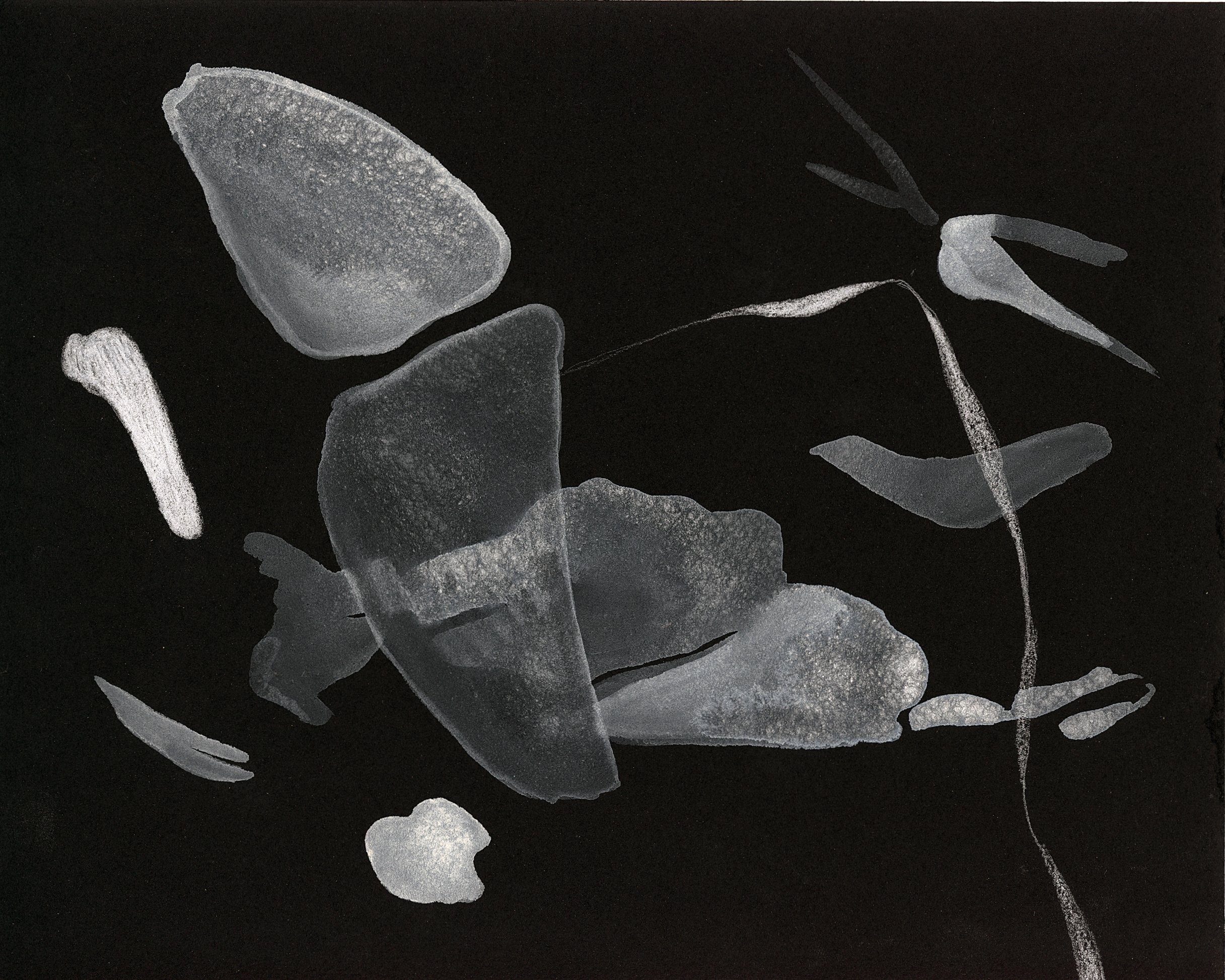
© Remnant 2 by Tia Forsman Spring 2022 Intima
“Radiographs serve as distilled moments of a human narrative,
An illness experience in greyscale” (From “Remnant” by Tia Forsman in the Spring 2022 Intima)
Sea glass/cutglass/eyeglass/stonefish/boomerang, Forsman’s remnants
Arrayed/x-rayed on the nightblack ocean floor of shapes and shadows.
From the French : to “rest”; to “remain”, “left over”; an underwater x-ray.
Overlapping, edges blurred, tenderly floating in an uncertain narrative.
This isn’t an x-ray. It just looks like one. Like medicine, a “grey area”
Forman is bilingual.. She paints in watercolor. She speaks in radiology.
Caring and the Challenges of Social Convention, by Jeffrey Millstein, MD
An internist reflects on his short story as well as a fellow physician’s personal essay and explores the complex issue of crossing implicit social boundaries in the clinician-patient relationship.
Read moreWe’re Invisible, Too: Showing Respect for Healthcare Workers by Cheryl Bailey
A retired gynecologic oncologist reflects on her own career and realizes how watercolor artwork can allow for even healthcare providers to be seen.
Read moreLeaning Close: "No more interventions. No more transfusions." A reflection on mortality and morbidity rounds by pediatrician-writer Laura Johnsrude
When I read “All Tuned Up” by Albert Howard Carter III (Spring 2021 Intima), I remembered a pediatric intensive care unit patient from my own 1980’s residency experience. In Carter’s poem, a medical resident presents a case during mortality and morbidity rounds. The resident is moved to tears as he tells the gathered audience about the death of a patient he knew well. A senior doctor “gently” offers context and says, “Maybe he was just tired.”
Mercifully, I’ve muffled memories from some of the deaths during my residency training in the pediatric intensive care unit. But I remember a slight girl of about sixteen with silky, wavy hair, lying in a metal-frame bed parallel to the wall against the window, in silhouette.
Read more
Quisque iaculis facilisis lacinia. Mauris euismod pellentesque tellus sit amet mollis.