
The barriers to healthcare brought upon us by the COVID-19 pandemic feel further away now, six years later. However, its lingering effects, along with new and longstanding obstacles, can still infringe upon the ways patients and healthcare professionals might prefer to connect as human beings.
In clinician Kirsten Myer’s poem Hands (Fall 2020 Intima), I was reminded of the pain of our social separation. Written when Myer, now a neurologist, was a medical student, the poem recounts a moment, early in the pandemic, as a medical student assists a birth. Given the extreme safety restrictions during that stressful time, she is concerned the mother is without a loved one—someone to hold her hand. No hand / ungloved to hold, she writes, and later, I wish I could have held the mother’s / hand / like my hand is held. The gloved hand becomes both a physical and symbolic image of the barrier between them. Even returning home, the medical student’s feeling of loss lingers at the thought of the support she could not give.
Fast forward to my poem Nurse (Spring 2026 Intima), which takes place post-pandemic. A challenging feeding tube procedure shifts from a moment of distress to a singalong through the comforting gesture of my nurse. We sing, her gloved hand in mine, if only with the goal of distraction, at which she succeeds. However, simultaneous to my pain and the surgeons working away, is her capacity to act upon her impulse of empathy and compassionate support. From this unfolds an experience of genuine connection and mutual enjoyment—a shared, positive feedback loop.
Most every procedure cannot be a singalong, and the severity of the pandemic cannot be understated. But what these two poems, side-by-side, have me wondering is whether the opportunity to respond with empathy and compassion, or social-emotional gestures of care toward patients, also benefits the well-being of healthcare professionals? What is lost when systemic barriers inhibit that capability? Is there a cost to their well-being? We already know there is for patients.
It makes me think about how the pandemic was met with solidarity and small gestures of care and compassion. The idea that acts of care in healthcare are less unidirectional and more a loop of mutuality is interesting to contemplate. Both poems demonstrate that it might be.
It begs the question: If the objective is to minimize suffering, yours and mine, as patient and healthcare professional, how do we gesture to each other around the barriers of an imperfect system? Is there any gesture of care too small?
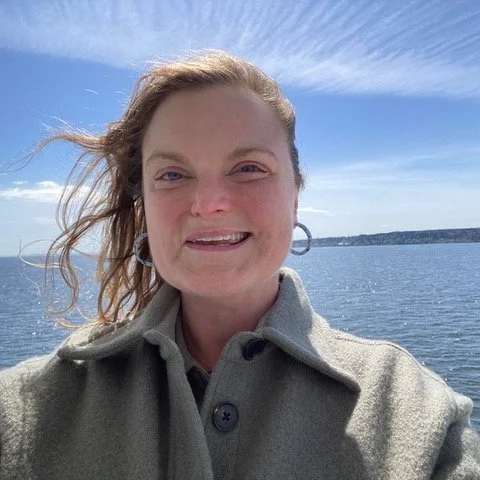
Rosa Singer
Rosa Singer is a poet, writer of creative non-fiction and the recipient of a double-lung transplant. Her writing explores braving the body, medical narratives, interdependence and the natural world. Passionate about the arts in health, she teaches expressive writing for patients and caregivers through the Lung Transplant Foundation. She also speaks at the University of Washington School of Medicine, on the topic of delivering and receiving serious news. Over a decade in the field of international development, working on girls’ sexual and reproductive health, showed her the importance of health as a human right and how stories remind us of our shared humanity. Today she writes and breathes next to a 200-year-old cedar tree in the beautiful Pacific Northwest.
