
Some doctors believe that when a patient is faced with a harsh or terminal prognosis, it’s best to promote hope in that patient. There is beautiful poetry and honesty about this topic in the essays “Doctoring and Disobedience” (Spring 2020 Intima) by Lisa Jacobs, a child, adolescent and adult psychiatrist, and “A Difficult Conversation” (Spring 2021 Intima) by Kelly Elterman, an anesthesiologist and writer in San Antonio, Texas. I urge everyone to read them and consider the value of truth at life’s end.
Read more‘I Am You’: A reflection about the revelation of close encounters in the clinical world by ASL interpreter Paul Hostovsky
I shared pages, as they say (those of us who make poems say it anyway) with Gabriel Hardman in the just published Fall-Winter 2026-27 issue of Intima. His poem “Skin,” which is about, among other things, pulling a bandage back on the wound of a young patient with old scars, comes right before my poem “Slippery,” which is about, among other things, a patient being given a bed bath.
Read moreMeet Norma: A Love Story in Cerebrospinal Fluid by Kenneth V. Iserson
Nobody warns you that the cure for a debilitating, often fatal brain disease is a length of silicone tubing with the personality of a retired DMV clerk. But there it is, threaded from my ventricles to my belly, quietly draining the excess cerebrospinal fluid that idiopathic normal pressure hydrocephalus (iNPH) kept pooling in my skull. I named it Norma, short for “normal pressure,” which felt optimistic at the time. Norma has never once lived up to it.
Read moreFrom Doing to Feeling: A reflection about difficult moments by resident physician Kirsten Myers
Poems make sense of the world. Both the poem “Not Compatible with Life” (Spring-Summer 2025 Intima) by writer Caroline Slater and my poem “I Closed His Eyes” (Spring-Summer 2026 Intima) illustrate the experience of being a healthcare professional in a difficult moment. There is almost a disassociation that occurs in the moment for me, and perhaps for Slater as well.
Read moreSeeing and Being Seen in a Clinical Encounter by psychiatric nurse practitioner Sarah Cady
When I first read Joseph Zarconi's poem American Sonnet for an Addict, I thought it was asking many of the same questions that concerned me while writing my essay Re: Interesting Case. Both seemed interested in the uneasy space between a person's experience and the clinical language used to describe it. But I kept returning to the way the poem begins: "The doctor drags his learning flock into my room."
Read moreWaking Without Her in the World: Remembering activist and writer Elena Schwolsky by Mario de la Cruz
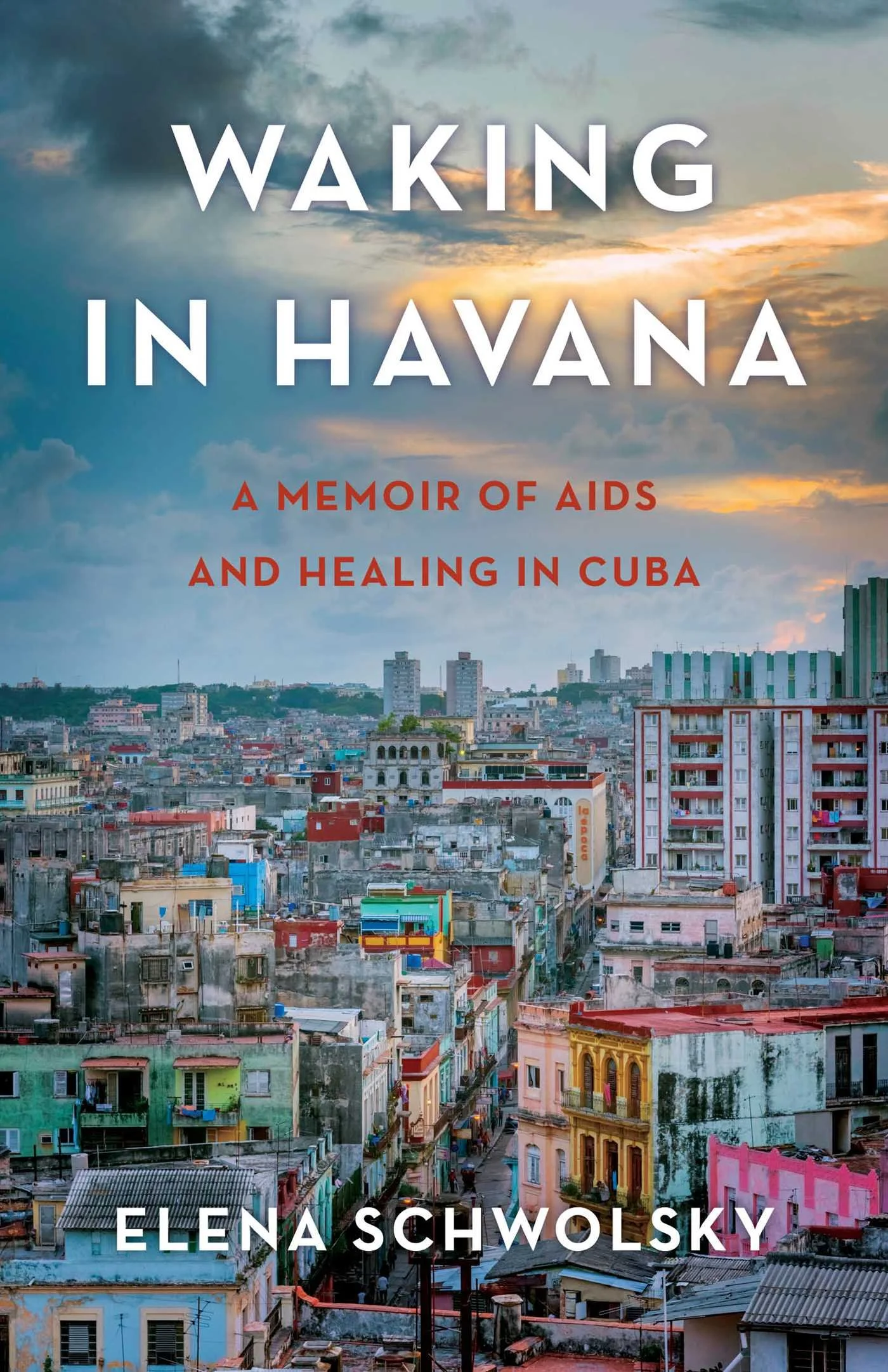
It has been a difficult time for many as of late — we've been witness to recent multiple losses of creative trailblazers, artists, activists and humanitarians. Some of them have been well-known, like Dolly Parton, Gloria Steinem and Cassandra Wilson, who we may have looked up to, learned from, aspired to be like and occasionally, had the chance to know personally, or call a friend. While she was not as easily recognizable to the public as the aforementioned women, Elena Schwolsky was a trailblazer, artist, activist, healer and humanitarian who inspired many and created vehicles for communication and connection. Elena left a deep impression on me.
Read moreAnswering Voltaire’s Call: How do you cultivate your soul garden? A reflection by family medicine nurse and medical humanities advocate Ariel Bugosh Boswell
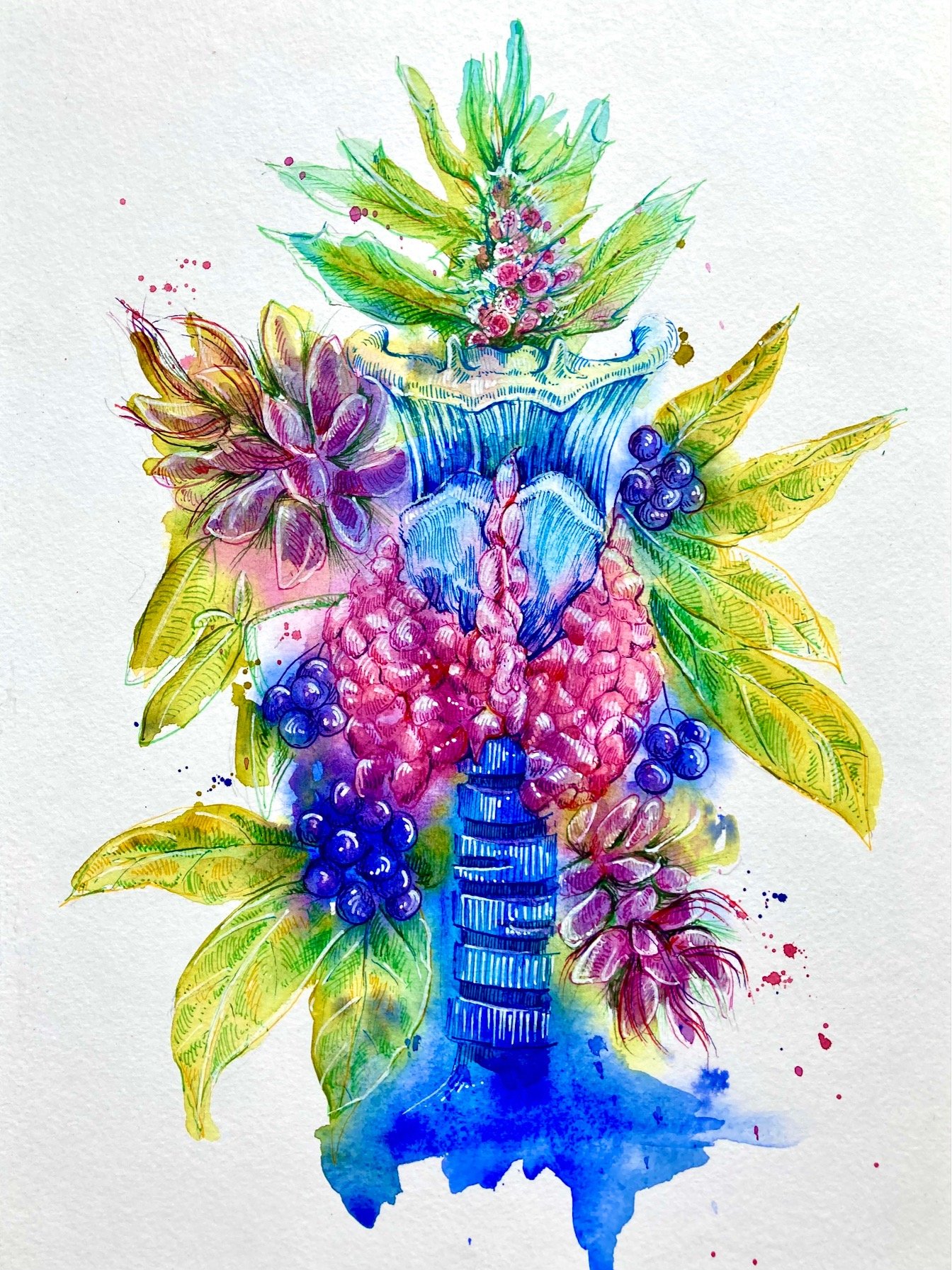
Anatomical Botanical: Thyroid by Sarah Elizabeth Lane
© Anatomical Botanical: Thyroid Sarah Elizabeth Lane Spring 2022 Intima
A real thyroid blushes dark pink, surrounded by lighter fascia and dappled with blood, but Sarah Elizabeth Lane’s vivid print “Anatomical Botanicals: Thyroid” (Spring 2022 Intima) transforms the muted tones of internal neck anatomy into a vivid floral bouquet. The trachea, like a striped blue vase, holds up folded red buds of thyroid surrounded by a profusion of berries and leaves. Via email, Lane let me know these plants are açaí and ashwaganda, and that she tries to limit her palette to three colors. Lane’s anatomy-related works push the medical eye to decontextualize the body from an aseptic, gritty, medico-industrial perspective and connect it with the beauty that feeds our souls.
Read moreWhat We Hear at the Dinner Table: A reflection by poet Jamie L. Smith about immigrant parents, their children, mental health and conversations we rarely have
Ellen Chang’s animated short, The Dinner Table (Spring 2026 Intima), beautifully illustrates intergenerational mistranslation, and the difficulty of bridging the divide between first-generation immigrants and their children when it comes to discussions of mental health. As the animation moves between Korean and English, what the daughter intends versus what the father hears, and what the father communicates versus what he means, the dining table at the center of the short lengthens and contracts, the distance between them widening and narrowing as they grapple for understanding.
Read moreI Want to Hold Your Hand: A reflection on barriers, well-being and gestures of care by writer Rosa Singer
If the objective is to minimize suffering, yours and mine, as patient and healthcare professional, how do we gesture to each other around the barriers of an imperfect system? Is there any gesture of care too small?
Read moreInitiating a Dialogue with Patients: The Power of Asking, Not Telling by Victoria Yuan

© Chronos Mind Heart. Mariana Ndrio. Fall 2025 Intima
In Mariana Ndrio’s “Chronos: Mind and Heart” (Spring 2025 Intima), crimson and white wires coil together, capturing the intricate relationship between thought and feeling. This symbiosis reminds me of some of the patients who informed my artwork titled “Pericardial Mnemosyne” (Fall 2024 Intima). Patients sometime delay treatment for their metastatic breast cancer because the diagnosis exhumes memories of family or friends who had complex experiences with breast cancer treatment and those who hadn’t survived. Without treatment, however, cancer cells can secret fluid into the sac around the heart – an effusion that swells and stifles the heart from pumping. During hospital stays, the treatment team not only drains the effusion but also opens up the conversation about treating cancer.
Read moreLearning How to Live While Knowing the Ending by Katerina Obscura
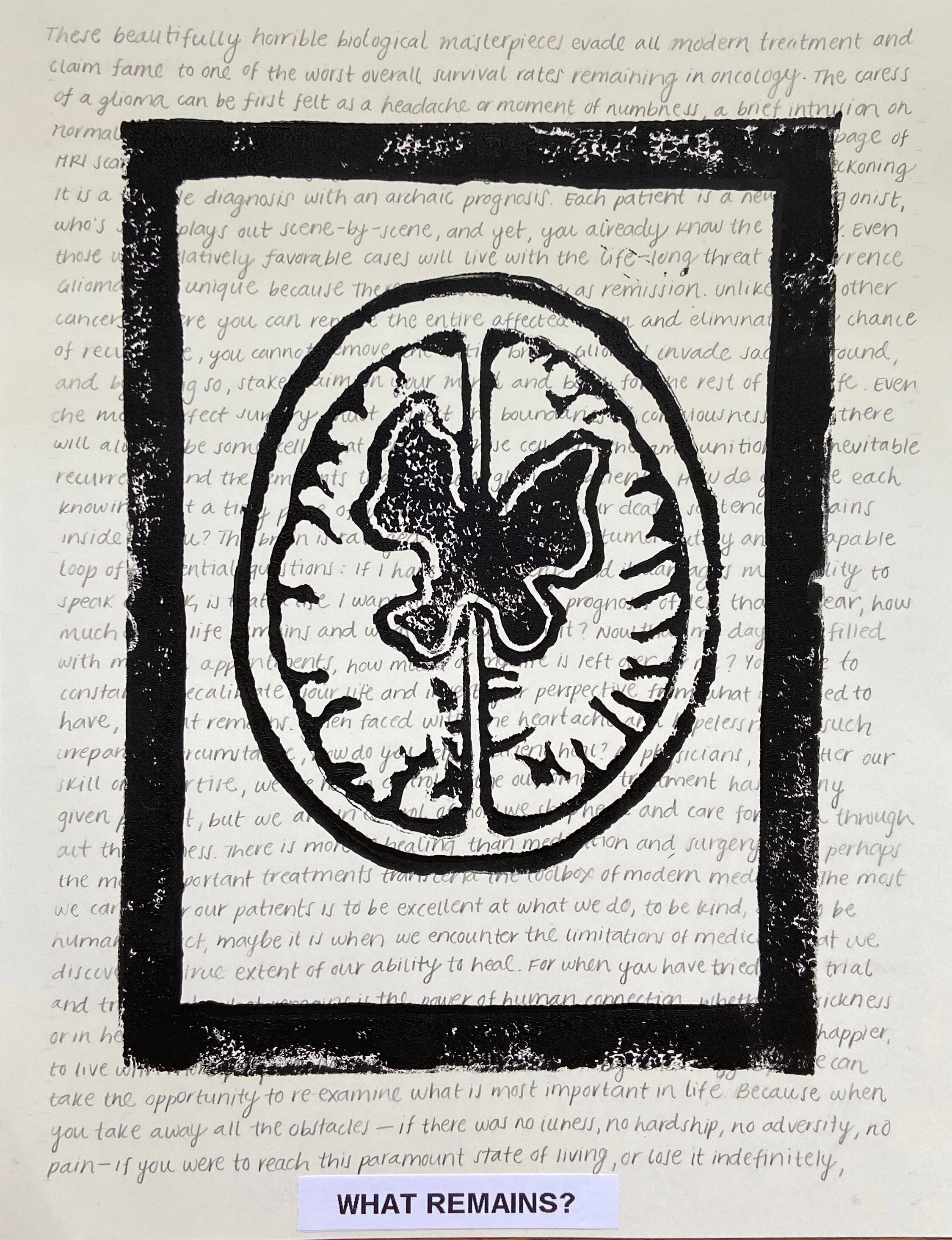
© What Remains. Alexandra Miner. Spring 2021 Intima: A Journal of Narrative Medicine
When I first encountered Alexandra Miner’s “What Remains” (Spring 2021 Intima) in the early days of my own glioma diagnosis, I finally exhaled a breath that I’d held deep down. My physicians did care! Despite losing so much function, and my grief over the life I’d built, the questions I spiraled on were valid! There is a priceless comfort in feeling seen in the uncertainty and cruelty of receiving a life-limiting diagnosis as a young(er) adult (YA).
Read moreWhat the Midwife Knew and I Learned by physician Guilherme Coelho
Nancy Glass’s Field Notes essay “What Did La Abuela See?” (Fall 2019 Intima) put me back inside a room I had stood in once, half a hemisphere away, on a wooden floor that smelled of cedar and boiled water.
Read moreOn Laughing Through the Pain by Albert Einstein College of Medicine medical student Moshe Gordon
Perusing Intima's last issue, I noticed some overlapping themes between two very different pieces: my own fictional piece “Sweet Dreams,” and “Humor As (Narrative) Medicine,” an autoethnographic study by Alyse Keller Johnson, an associate professor of communication studies at CUNY Kingsborough Community College in Brooklyn.
Read moreWhat Do Doctors Get From Name-Calling? A reflection about our reaction to ‘difficult patients’ by nephrologist and educator Joseph Zarconi
Palo Alto neurologist Kendra Peterson's poem “Difficult Patient” (Fall 2017 Intima: A Journal of Narrative Medicine), and the patient who inspired my “American Sonnet for an Addict” (Fall-Winter 2025-26 Intima) are prototypical victims of name-calling – a ubiquitous clinical behavior taught exclusively in the so-called hidden curriculum of medical education. These patients are our albatrosses, another name we ascribe, recalling the curse that befell the entire ship’s crew of Samuel Taylor Coleridge’s famous mariner following his killing of an albatross in the poem, “The Rime of the Ancient Mariner.” They curse us. They burden and encumber us.
Read moreWhere Fear About Living and Dying is Held: A reflection by UC San Diego internal medicine resident Tulsi Patel
When I read the Field Notes essay “Letter to My Oncologist” (Fall 2025 Intima), I was struck by how the writer, psychologist Julia Dobner-Pereira, watches her physician for the smallest fracture of a moment in composure—and how the physician watches her for the same. Their exchanges sit on a narrow ledge—two people trying to hold each other’s fear without admitting how much weight they’re carrying. I recognized that terrain immediately. As a clinician, I’ve felt patients monitor my breathing, my pauses, my half-smiles.
Read moreIn Story Lies the Cure by MD Ron Turker
“Young doctors are young for a blink, and they age with their patients. My advice to my young colleagues: knock first and then, most importantly, listen for the response. Listen for their story. In story lies the cure.”
Read more"Who knew that time was the biggest factor in compassion?" A reflection about effective clinical care by writer Lisa Simone Kingstone
“The center was my rest stop in my trek through cancer. It shimmers through my own understanding of how to care for people…But over a decade later, what I remember most is a feeling of restoration. … Being a patient makes you feel like a baby in a basket floating down a river with rapids.”
Read moreWhat is Grief-Sight? Writer and researcher Valk Fisher reflects on what prompts it.
I began to see grief everywhere.
A diagnosis started it, though I didn’t know, exactly, what I was seeing. I had no words for the gnawing inside my gut, the tightness beneath my sternum, the exhales that were just that much heavier. Grief was everywhere, but nameless. It became larger and louder until I could sense it, name it, be with it, speak about it. Only then did I begin to smile – really smile – again.
Grief will require it be Seen.
Read moreHow Big Moments Hide in the Mundane Ones: A reflection by Intima editor Priya Amin
“Leaving my homeland means carrying these uncertainties with the knowledge that a phone call, an email, a single test result can change the shape of a life we thought we knew. But like sea glass, we are shaped by what we endure, softened by time, and held together by the stories we share across miles and years.”
Read moreThe Power of Stories to Change Attitudes: A reflection by fiction editor Daly Walker
“How can people in our country be convinced it is right to share our bounty with the world’s less fortunate?”
Read more
Quisque iaculis facilisis lacinia. Mauris euismod pellentesque tellus sit amet mollis.