
• Mission and Vision
    • The Editors
    • Advisory Board
    • Contact
    • Contributors
    • Fiction
    • Field Notes
    • Non-Fiction
    • Poetry
    • Studio Art Spring 2026
    • Audio and Videos
    • Studio Art Fall 2025
    • Academic
    • SPRING-SUMMER 2026 INTIMA
    • CONTRIBUTORS SPRING 2026
  • CROSSROADS
    • WHERE IT HURTS: DISPATCHES FROM THE EMOTIONAL FRONTLINES OF MEDICINE
    • BOOK REVIEWS
    • Submit a Book Review
    • ARCHIVES UPDATE
    • Academic - A-L
    • Academic - M-Z
    • Fiction - A-L
    • Fiction - M-Z
    • Field Notes - A-L
    • Field Notes - M-Z
    • Multimedia
    • Multimedia Fall 2015
    • Multimedia Fall 2016
    • Non-fiction A-L
    • Non-Fiction M-Z
    • Poetry - A-F
    • Poetry G-L
    • Poetry - M-Z
    • Studio Art Spring 2025
    • Studio Art Fall 2024
    • Studio Art Spring 2024 Fall 2023
    • Studio Art Spring 2023
    • Studio Art Fall 2022
    • Studio Art Spring 2022
    • Studio Art Spring 2021
    • Studio Art Fall 2020
    • Studio Art to 2013
    • Studio Art Spring 2015
    • Studio Art - Fall 2015
    • Studio Art Spring 2016
    • Studio Art Fall 2016
    • Studio Art Spring 2017
    • Studio Art Fall 2017
    • Studio Art + Multimedia Spring 2018
    • Studio Art Fall 2018
    • Studio Art Spring 2019
    • Studio Art -Fall 2019
    • Studio Art Spring 2020
    • Contributors
    • Contributors SPRING 2015
    • Contributors FALL 2015
    • Contributors Fall 2016
    • Contributors Fall 2017
    • Contributors Fall 2018
    • Contributors Fall 2019 Intima
    • Contributors Spring 2020 Intima
    • Contributors Fall 2020 Intima
    • THE ESSAY CONTEST
    • Submission Guidelines
Menu

Intima

Street Address
City, State, Zip
Phone Number
A Journal of Narrative Medicine

Your Custom Text Here

Intima

  • About
    • Mission and Vision
    • The Editors
    • Advisory Board
    • Contact
    • Contributors
  • OUR CURRENT ISSUE
    • Fiction
    • Field Notes
    • Non-Fiction
    • Poetry
    • Studio Art Spring 2026
    • Audio and Videos
    • Studio Art Fall 2025
    • Academic
    • SPRING-SUMMER 2026 INTIMA
    • CONTRIBUTORS SPRING 2026
  • CROSSROADS
  • BOOKS
    • WHERE IT HURTS: DISPATCHES FROM THE EMOTIONAL FRONTLINES OF MEDICINE
    • BOOK REVIEWS
    • Submit a Book Review
  • Archives
    • ARCHIVES UPDATE
    • Academic - A-L
    • Academic - M-Z
    • Fiction - A-L
    • Fiction - M-Z
    • Field Notes - A-L
    • Field Notes - M-Z
    • Multimedia
    • Multimedia Fall 2015
    • Multimedia Fall 2016
    • Non-fiction A-L
    • Non-Fiction M-Z
    • Poetry - A-F
    • Poetry G-L
    • Poetry - M-Z
    • Studio Art Spring 2025
    • Studio Art Fall 2024
    • Studio Art Spring 2024 Fall 2023
    • Studio Art Spring 2023
    • Studio Art Fall 2022
    • Studio Art Spring 2022
    • Studio Art Spring 2021
    • Studio Art Fall 2020
    • Studio Art to 2013
    • Studio Art Spring 2015
    • Studio Art - Fall 2015
    • Studio Art Spring 2016
    • Studio Art Fall 2016
    • Studio Art Spring 2017
    • Studio Art Fall 2017
    • Studio Art + Multimedia Spring 2018
    • Studio Art Fall 2018
    • Studio Art Spring 2019
    • Studio Art -Fall 2019
    • Studio Art Spring 2020
    • Contributors
    • Contributors SPRING 2015
    • Contributors FALL 2015
    • Contributors Fall 2016
    • Contributors Fall 2017
    • Contributors Fall 2018
    • Contributors Fall 2019 Intima
    • Contributors Spring 2020 Intima
    • Contributors Fall 2020 Intima
    • THE ESSAY CONTEST
  • Submissions
    • Submission Guidelines

Learning How to Live While Knowing the Ending by Katerina Obscura

August 14, 2026 Intima: A Journal of Narrative Medicine

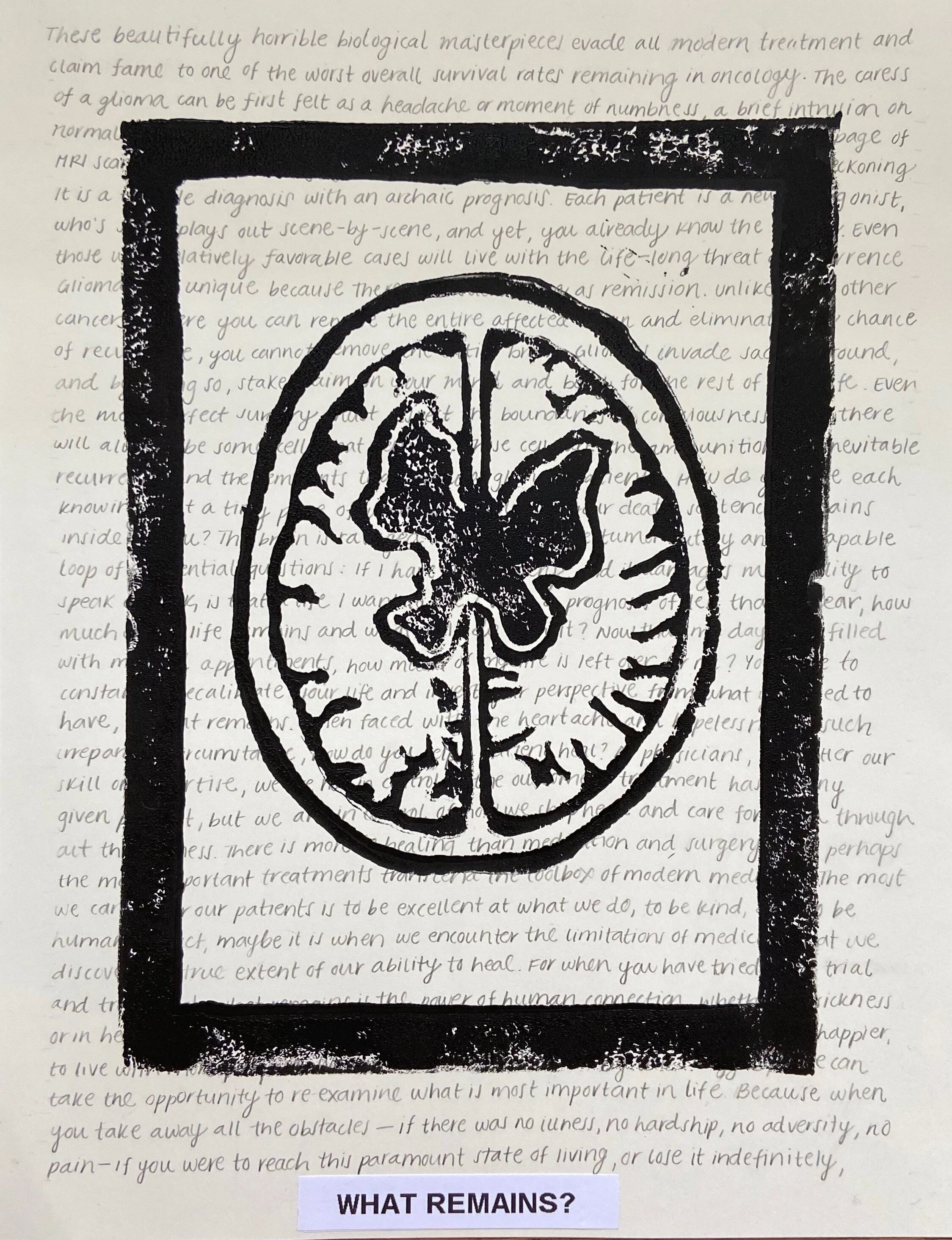
© What Remains. Alexandra Miner. Spring 2021 Intima: A Journal of Narrative Medicine

When I first encountered Alexandra Miner’s “What Remains” (Spring 2021 Intima) in the early days of my own glioma diagnosis, I finally exhaled a breath that I’d held deep down. My physicians did care! Despite losing so much function, and my grief over the life I’d built, the questions I spiraled on were valid! There is a priceless comfort in feeling seen in the uncertainty and cruelty of receiving a life-limiting diagnosis as a young(er) adult (YA).

“What Remains” was published when Miner was a second-year medical student at Virginia Tech Carilion School of Medicine in Roanoke, Virginia, and held particular meaning: Reading Miner’s words, I was reminded that med students are not yet hardened by the horrific carousel of routinely treating gliomas. I was hopeful that somewhere inside each of my specialists, their younger self recognized me as an individual, a protagonist whose story matters. “What Remains” confirmed what I had pieced together in my reading and learning about my prognosis; it gave words to the dark cloud stalking me. It helped me accept what medical language meant in practical terms for me, my loved ones and our foreseeable future.

As complications mounted in the early years of my diagnosis, it became increasingly clear that a quick return to my ‘before’ wasn’t in the cards. I sought solace in practices I loved but often neglected in my fast-paced, former life. I eventually restarted journaling and picked up a camera again. These initial returns to creative endeavors were an attempt to help me manage the flashbacks I was experiencing since being hospitalized in overcrowded brain injury wards at the height of the COVID-19 pandemic. 
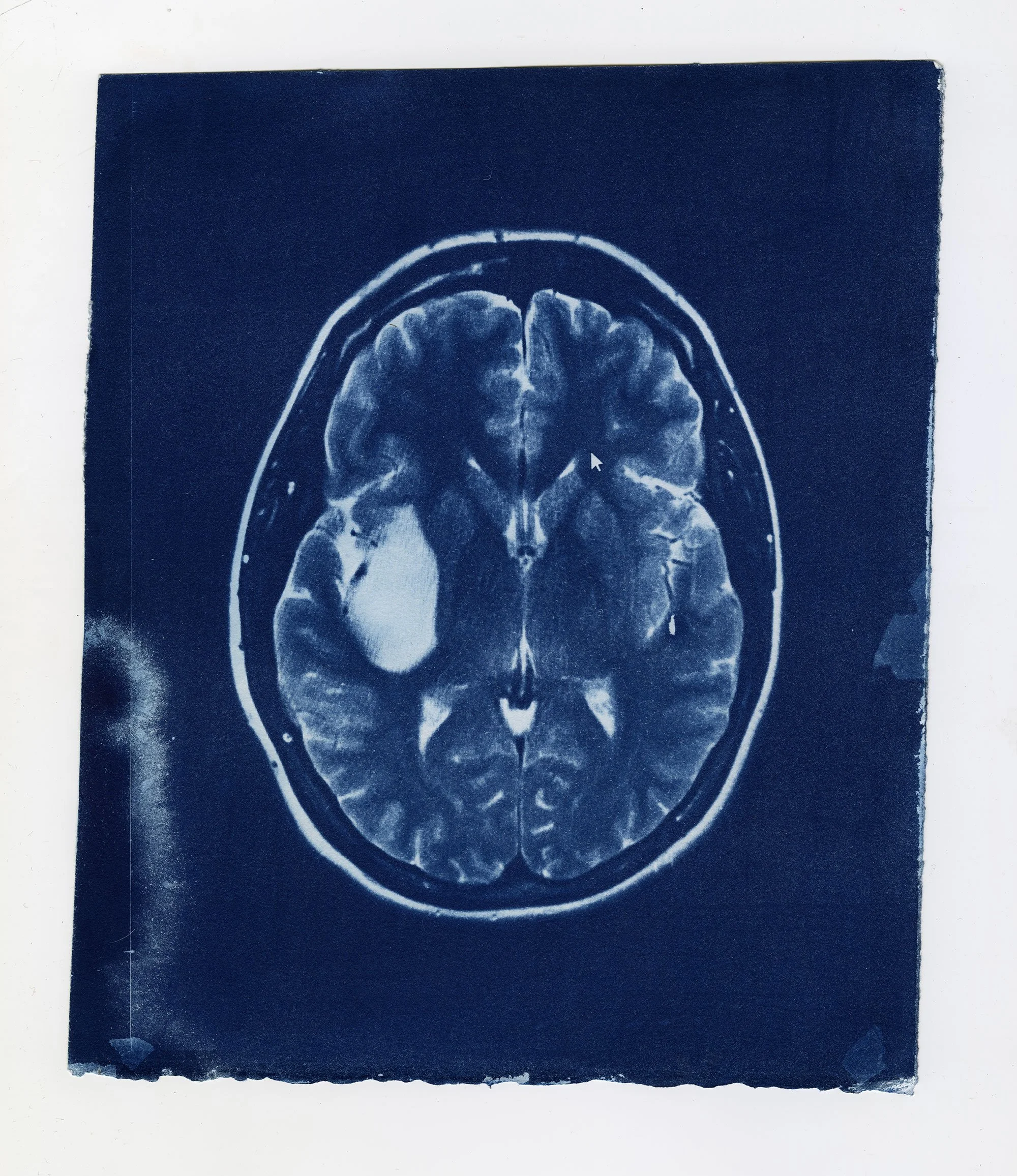
© Beautiful In Blue: Finding a Sense of Agency and Awe in Printing My Glioma by Katerina Obscura. Cyanotype print on watercolor paper

I eventually looked to fellow YA’s who’ve defied the constraints of their own chronic illnesses or histories of cancer for a roadmap of how to cope, their glimmers of hope alighting the dark path before me. I found comfort in the art, writings and virtual communities of Suleika Jaouad, Caroline Catlin, Chelsey Gomez and Sophie Strand; contributors to Intima, and the prolific legacy of crip creatives (Brough,1) whose shoulders we stand on also proved invaluable. I found a dialect and comfort that not only mitigated my trauma but also better equipped me to embrace the vulnerability of exploring my fears and uncertain future through more intentional written reflection, photography and printmaking. The longer and slower I work to understand my new reality, the more inspiration I find for creatively exploring my diagnoses and disabilities in a paced, accessible way.

Miner’s “What Remains” may have been created early in Miner’s medical schooling, but fortunately for me, those words found me early in my glioma journey, nudging me to return to neglected pursuits, ultimately helping me to understand my new reality and find meaning as I lived my own middle ‘while knowing [my] ending’ (Miner).

Katerina Obscura

Katerina Obscura is a young adult, who is based in rural Canada and living with a life limiting cancer and resultant disabilities. A geographer by education, Obscura's art uses analogue and historical processes to consider the ephemerality of human life and our connections to nature. Photography and printmaking enable her a sense of control that she has lost in most other areas of her life since her diagnosis. Her artwork “Beautiful in Blue: Finding a Sense of Agency and Awe in Printing My Glioma” appears in the Spring-Summer 2026 Intima:

In death and dying, illness narratives, empathy Tags glioma, crip creatives, suleika jaouad, hope, illness, narratives, journaling, creative, voice
Voices That Remain: A dialogue about mentors, memory and what matters →
Summary Block
This block is invalid. Please check the block settings and try again.
Featured
Aenean eu leo Quam
Aenean eu leo Quam

Quisque iaculis facilisis lacinia. Mauris euismod pellentesque tellus sit amet mollis.

Read more →

Intima: A Journal of Narrative Medicine
Copyright ©2026
ISSN 2766-628X