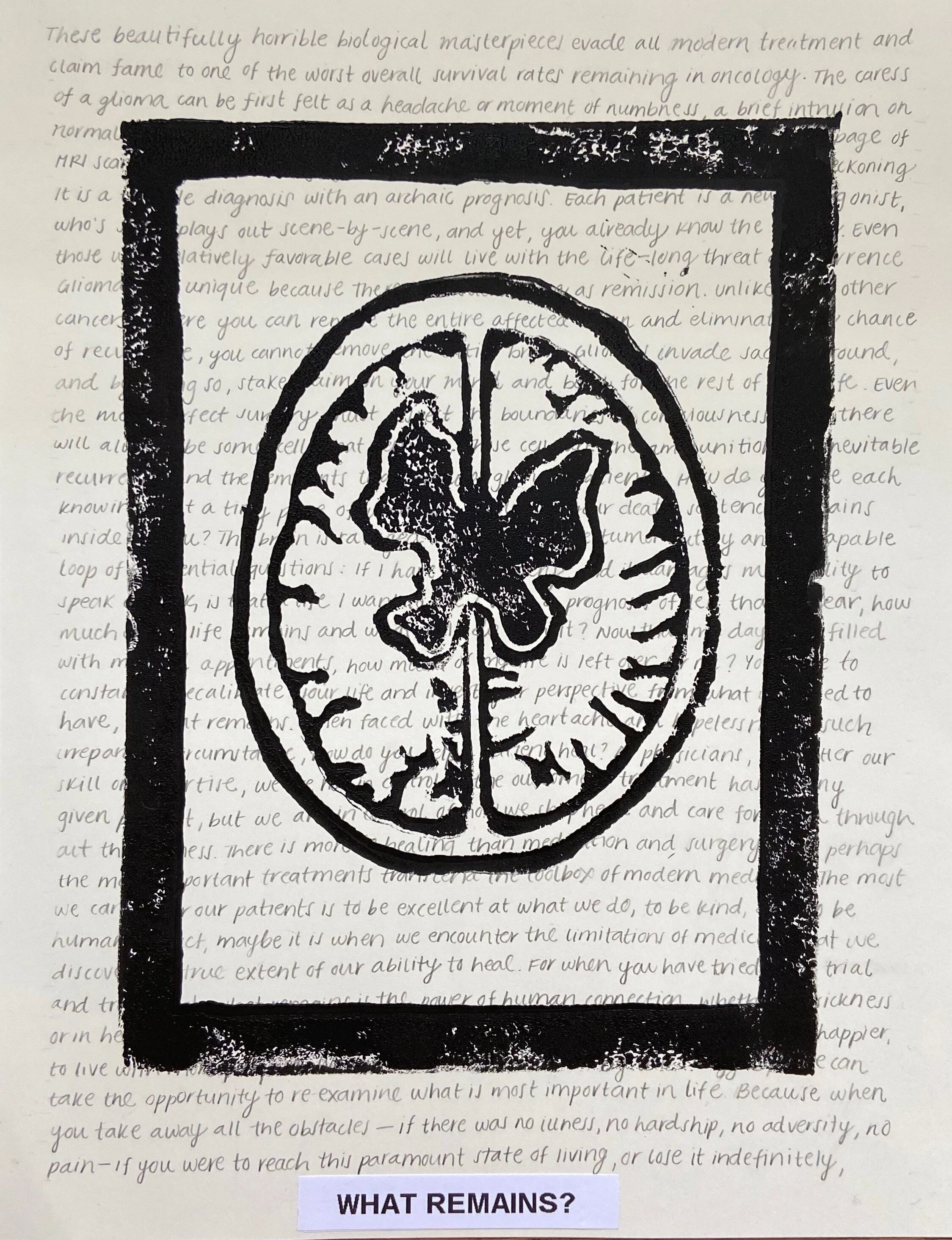
When I first encountered Alexandra Miner’s “What Remains” (Spring 2021 Intima) in the early days of my own glioma diagnosis, I finally exhaled a breath that I’d held deep down. My physicians did care! Despite losing so much function, and my grief over the life I’d built, the questions I spiraled on were valid! There is a priceless comfort in feeling seen in the uncertainty and cruelty of receiving a life-limiting diagnosis as a young(er) adult (YA).
Read moreNeurologist Kendra Peterson explored reactions to “The Difficult Patient” in her poem (Fall 2017 Intima) nearly a decade ago. Long before chart cloning and copy forward worked their way into the documentation of the clinical relationship between patient and physician via the keystrokes and dot phrases of the electronic medical record, caregivers have developed shortcuts of stereotyping and rapid assessment that make their lives easier. Clinical gestalt is often celebrated, while bias is treated as something separate from it. And is the label “difficult” any different than the convenience of using yesterday’s assessment as the foundation for today’s decisions? Is propagation of a name or a label such as ‘difficult patient’ a type of plagiarism?
Read moreA pharmacist fiercely advocates for lasting change via a healing framework.
Read moreA nurse contemplates how and why patients are made to feel like burdens—simply for having several needs.
Read more“Sometimes the job we do isn’t about fixing what’s wrong but rather helping each other survive within the confines of our brokenness.” Artwork: The Art of Being Here by Kirilee West Spring 2022 Intima
Read moreA medical educator reflects on studio art recently published in the Intima and examines the boundaries—real or imagined?—often constructed between mind and body.
Read moreDisordered eating occupies a spectrum—anorexia nervosa at one end, morbid obesity at the other. Attempting rigid control of the body and its appetites, anorexics are unable to see themselves and their bodies accurately. Compulsive overeaters—often obese—similarly might not see themselves accurately. In both disorders, controlling food is the aim, a genuine addiction, a strategy through which addicts deal with the world and their own circumstances—a necessary coping skill, even though it is risky to health in both cases.
Read more
Quisque iaculis facilisis lacinia. Mauris euismod pellentesque tellus sit amet mollis.