
When I first read Joseph Zarconi's poem American Sonnet for an Addict, I thought it was asking many of the same questions that concerned me while writing my essay Re: Interesting Case. Both seemed interested in the uneasy space between a person's experience and the clinical language used to describe it. But I kept returning to the way the poem begins: "The doctor drags his learning flock into my room."
Before the patient in Zarconi’s poem tells us her story, she already seems to understand the encounter. More strikingly she seems to know how she is spoken about when she is not in the room. "The hopeless drunk in for the umpteenth time on her way to the grave" sounds less like a judgment she is hearing for the first time than one she has heard often enough to repeat herself. When asked when the drinking began, she answers with a story that completely reorganizes what everyone in the room thinks they know. We learn about the death of a child, the unraveling of a family and the grief that preceded the drinking. She is not simply the subject of the poem, but its narrator.
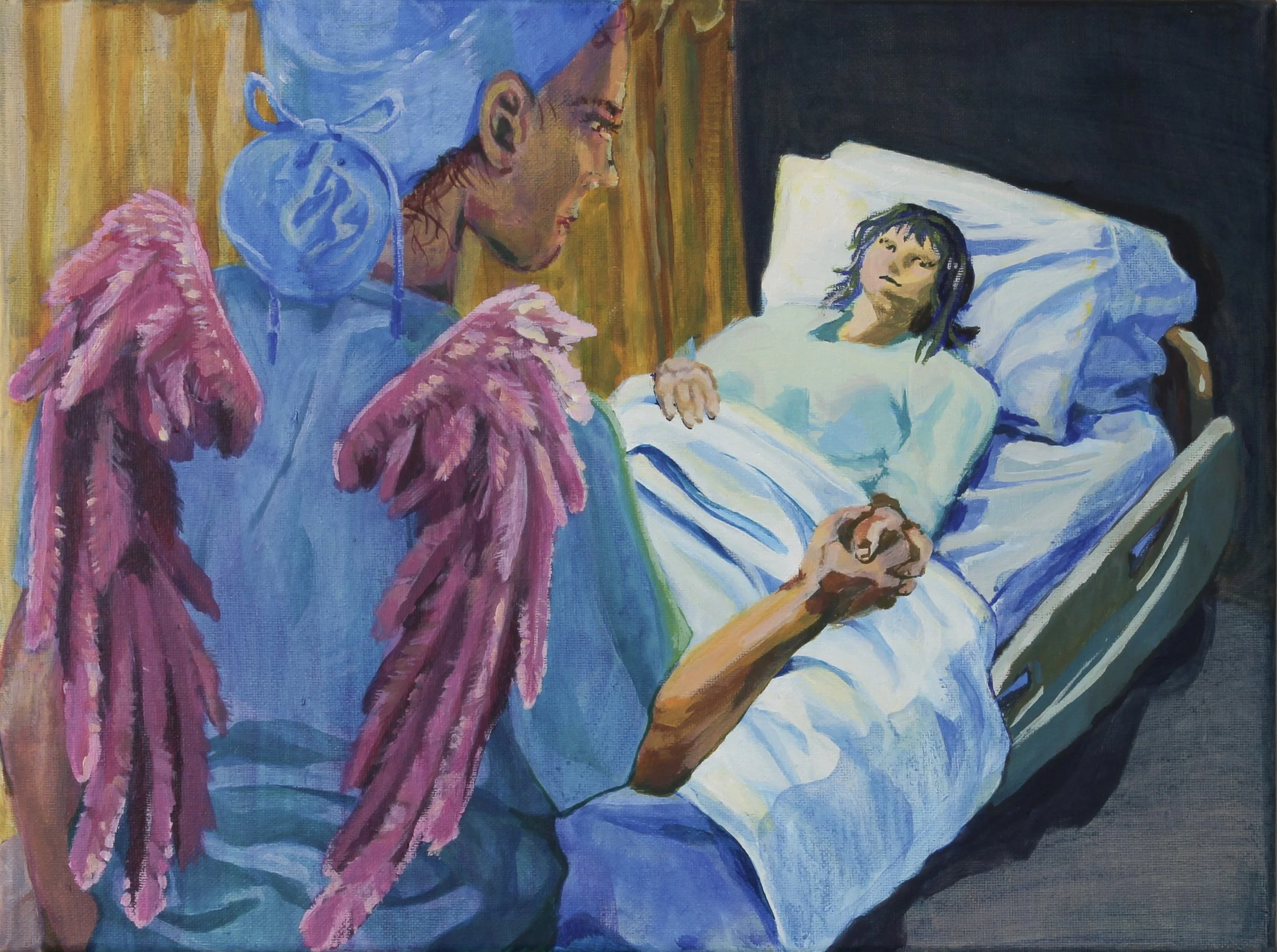
Guardian Angel
© Hidden Lore Guardian Angel by Annie Chen. Acrylic on canvas. Spring 2026 Intima: A Journal of Narrative Medicine
While writing my essay, I was occupied by a different side of that encounter. The poem begins with a patient who is acutely aware of how she is being seen. My essay follows my growing awareness of how I am seeing. Returning to my essay after reading the poem by Zarconi, who is a university professor emeritus at the Northeast Ohio Medical University in Rootstown, Ohio, I found myself confronting a different discomfort. The patient in my essay speaks, but her experience is presented primarily through observation, documentation and clinical discussion. While I critique the phrase "interesting case," I simultaneously present a suffering woman as one. The distance between experience and description remains important to both, but what lingered for me in Zarconi's poem was something simpler: a patient who already understands how she is being seen, and who tells a different story than the one the room expected to hear.—Sarah Cady
Sarah Cady is a psychiatric nurse practitioner working in New York City.
