
When I first read Joseph Zarconi's poem American Sonnet for an Addict, I thought it was asking many of the same questions that concerned me while writing my essay Re: Interesting Case. Both seemed interested in the uneasy space between a person's experience and the clinical language used to describe it. But I kept returning to the way the poem begins: "The doctor drags his learning flock into my room."
Read moreAnswering Voltaire’s Call: How do you cultivate your soul garden? A reflection by family medicine nurse and medical humanities advocate Ariel Bugosh Boswell
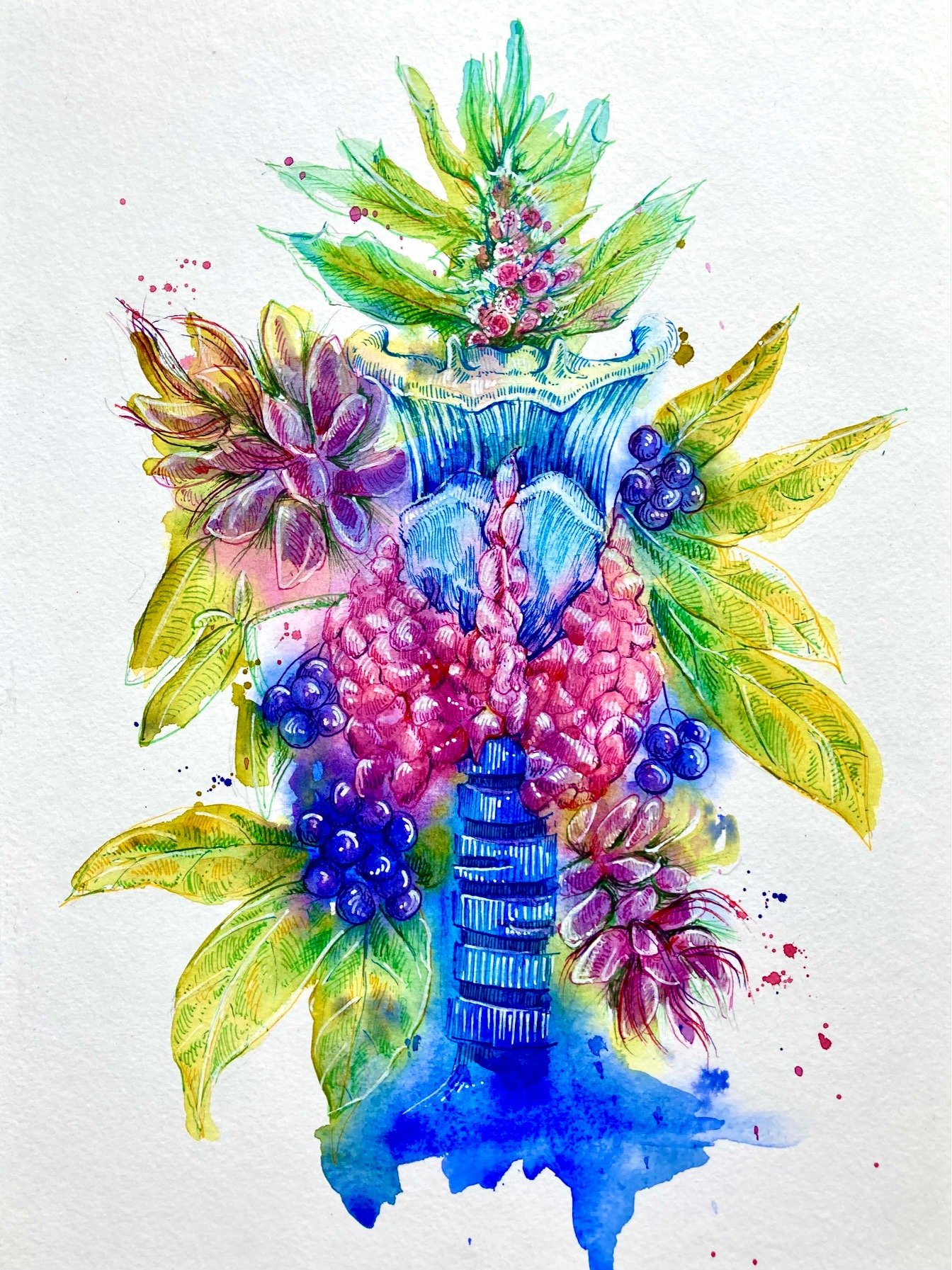
Anatomical Botanical: Thyroid by Sarah Elizabeth Lane
© Anatomical Botanical: Thyroid Sarah Elizabeth Lane Spring 2022 Intima
A real thyroid blushes dark pink, surrounded by lighter fascia and dappled with blood, but Sarah Elizabeth Lane’s vivid print “Anatomical Botanicals: Thyroid” (Spring 2022 Intima) transforms the muted tones of internal neck anatomy into a vivid floral bouquet. The trachea, like a striped blue vase, holds up folded red buds of thyroid surrounded by a profusion of berries and leaves. Via email, Lane let me know these plants are açaí and ashwaganda, and that she tries to limit her palette to three colors. Lane’s anatomy-related works push the medical eye to decontextualize the body from an aseptic, gritty, medico-industrial perspective and connect it with the beauty that feeds our souls.
Read moreInitiating a Dialogue with Patients: The Power of Asking, Not Telling by Victoria Yuan

© Chronos Mind Heart. Mariana Ndrio. Fall 2025 Intima
In Mariana Ndrio’s “Chronos: Mind and Heart” (Spring 2025 Intima), crimson and white wires coil together, capturing the intricate relationship between thought and feeling. This symbiosis reminds me of some of the patients who informed my artwork titled “Pericardial Mnemosyne” (Fall 2024 Intima). Patients sometime delay treatment for their metastatic breast cancer because the diagnosis exhumes memories of family or friends who had complex experiences with breast cancer treatment and those who hadn’t survived. Without treatment, however, cancer cells can secret fluid into the sac around the heart – an effusion that swells and stifles the heart from pumping. During hospital stays, the treatment team not only drains the effusion but also opens up the conversation about treating cancer.
Read moreLiving Alongside Loss: A reflection on grief, rituals, and gratitude by Diego R. Hijano

© Womb by Johanna Glaser. Acrylic paints, linocut prints, tissue paper and pens.
“I made this collage as a gift for a pregnant friend using a mixture of acrylic paints, linocut prints, tissue paper and pens. It is inspired by and directly draws upon elements from a portrait of a young dead woman by Egon Schiele. At the time, I was in the middle of a palliative care fellowship and personally recovering from a severe IBD flare. It is a meditation on birth, illness, joy, pain and death; an expression of awe as to how humans can simultaneously be wounded, age, heal, celebrate and create throughout the seasons of our lives.”
Johanna Glaser’s collage “Womb” (Fall-Winter 2025-26 Intima) challenges the idea that life unfolds in emotional stages. Instead, it holds simultaneity:
Birth beside illness.
Joy beside grief.
Healing beside wounding.
Presence beside absence.
That duality emerges in writer and educator Valk Fisher’s Field Notes essay “Diary of a Plunge Year” (Spring-Summer 2025 Intima) and my short story “The Other Son” (Spring-Summer 2026 Intima). Both explore how rituals, whether running beside the ocean or gathering around a table, allow people to live alongside loss without being entirely consumed by it.
Read moreWhat the Midwife Knew and I Learned by physician Guilherme Coelho
Nancy Glass’s Field Notes essay “What Did La Abuela See?” (Fall 2019 Intima) put me back inside a room I had stood in once, half a hemisphere away, on a wooden floor that smelled of cedar and boiled water.
Read moreWhat Remains When the Body Is Taken Apart: A reflection on the educational ritual of anatomy class by Elli Lee

© Seeds of Life by Elli Youngeun Lee. Oil and colored pencil on canvas
“The first time I saw a dead body was in the cadaver lab. Behind fogged glasses, I felt my chest tighten as I faced my willed donor. But soon after, I found myself dissecting layers of skin and rifling through organs with the detachment of studying pages of a textbook. Anatomy lab is a pivotal step in our medical education. In fragmenting the human body as deidentified pieces of knowledge, it guides our hands through the otherwise unseen subjects of disease and reinforces our interconnectedness. In ‘Seeds of Life,’ the flowers honor these physical bodies as vessels of the donors’ time on earth—reminders that, through their gift, our growth and our future patients’ healing take root.”
In “Seeds of Life,” I reflected on the first time I encountered death—not as a moment of mourning, but as an educational threshold. In the anatomy lab, my donor’s body became a site of learning: layers to be dissected away, structures to be identified, systems to be mastered. Standing before the body, I dreaded the day we would come face-to-face with our donor and dissect his facial structures. Yet when that day arrived, the emotions I anticipated were absent. Without my noticing, a transition had occurred: this encounter with death was no longer about loss, but about participation in an educational ritual. Though this shift felt necessary and even expected, it left behind a quiet unease. In learning to see the body clearly, I wondered if I was learning to stop seeing.
Read moreWhat Do Doctors Get From Name-Calling? A reflection about our reaction to ‘difficult patients’ by nephrologist and educator Joseph Zarconi
Palo Alto neurologist Kendra Peterson's poem “Difficult Patient” (Fall 2017 Intima: A Journal of Narrative Medicine), and the patient who inspired my “American Sonnet for an Addict” (Fall-Winter 2025-26 Intima) are prototypical victims of name-calling – a ubiquitous clinical behavior taught exclusively in the so-called hidden curriculum of medical education. These patients are our albatrosses, another name we ascribe, recalling the curse that befell the entire ship’s crew of Samuel Taylor Coleridge’s famous mariner following his killing of an albatross in the poem, “The Rime of the Ancient Mariner.” They curse us. They burden and encumber us.
Read moreWhy are patients hesitant to tell the truth? A reflection on communication by public health scientist and activist Mariana Mcdonald
Communication. Open and forthright—what we want as patients and what providers require of us. But that can be difficult, as reflected in my short story “The Vent,” (Intima Fall 2025), where I explore a seriously injured man’s thoughts in the ICU. He complains: “Every time I went in to the clinic, they started asking the exercise question, no matter what I was there for. Got the flu, feverish and coughing, and there they are quizzing me about exercise.” His frustrations lead him to respond dishonestly to his providers’ questions: “It got so I would tell them what I thought they wanted to hear just to get them off my back. Said I took a walk every day, hardly ever drank... All lies, or fibs...”
Read moreIn Story Lies the Cure by MD Ron Turker
“Young doctors are young for a blink, and they age with their patients. My advice to my young colleagues: knock first and then, most importantly, listen for the response. Listen for their story. In story lies the cure.”
Read moreWhat is Grief-Sight? Writer and researcher Valk Fisher reflects on what prompts it.
I began to see grief everywhere.
A diagnosis started it, though I didn’t know, exactly, what I was seeing. I had no words for the gnawing inside my gut, the tightness beneath my sternum, the exhales that were just that much heavier. Grief was everywhere, but nameless. It became larger and louder until I could sense it, name it, be with it, speak about it. Only then did I begin to smile – really smile – again.
Grief will require it be Seen.
Read moreHow Art Inspires: Looking at “The Wish” by primary care physician Megan Gerber. A reflection by Colleen Cavanaugh

© The Wish. Megan Gerber. Mixed-Media: Acrylic, ink and tissue paper on canvas. Spring 2025 Intima
Although many of my non-fiction stories dwell on loss, there is always a lesson to be learned or an inspiration which somehow has evolved into compassion. In “The Lingerie Shop” (Spring 2025 Intima), I recall my adolescent years when I learned about my mother’s breast cancer. I was haunted by her embarrassment and loneliness. The emotions were part of my upbringing and I lived side by side with them. It must have changed me. I attended medical school and became a gynecologist, caring for many women with breast cancer. My loss had metamorphosed into strength and compassion. My loss made me a better doctor.
Read moreTwo Doctors, Two Cancer Diagnoses by Susan Schuerman Murphy
I met my husband, Kim, on a bone marrow transplant unit in a cosmic display of foreshadowing ten years before the happenings in my piece “Suffer the Little Beagles.” I was First Lieutenant Schuerman serving as a bone marrow transplant nurse. He was a Captain who had ventured up four floors to place his pathology report in a patient’s chart. Over the next decade we married, I became an attorney, we became civilians, I gave birth to our daughter, and we bought a big house. He told me about his deep bruises and enlarged spleen the night we lay exhausted on our bed after having received our household goods.
Read morePrayers: A Reflection by Angela Tang-Tan
I hesitated to write “Top Surgery,” and I hesitated even more to submit it. In it, I wrote that “I stand with my back to the wall, drawing silence around me like armor.”
Read moreUn/Burdened: A reflection by physician/poet Ryan Boyland about empathy, self-care and shared joy
I leave the hospital, but the hospital doesn’t always leave me. I carry my stress in a thin band across my upper back. On the good days, I think about a patient I sent to a recovery center. I think I did a good job. On the bad days, I find myself scrolling for far too long, when another shift is coming in entirely too few hours, because, as I wrote in my poem “Omens,” “while I am awake, he is still alive.”
Read moreHow to Have Empathy for Others As Well as Ourselves: A Reflection by clinician Jennifer Anderson
As I read Sarah Gundle’s essay “I Can’t Remember His Name” (Intima, Spring 2023), I recognized a young and eager clinician who felt both moved by someone’s story and inept at affecting change, a dissonance that can reverberate throughout decades of practice. I, too, remembered my earliest encounters, when my own therapeutic skin was most supple and soft, vulnerable to the bruising weights of trauma, addiction and injustice. I recognized the writer’s spontaneous tears – and the impulse to minimize and dismiss them in accordance with the guidelines of rational detachment and therapeutic rapport.
Read moreDeepening Insights on Metaphors for Pain and Medical Care by Vilmarie Sanchez-Rothkegel
In my non-fiction essay "House of Pain" essay (Fall 2024 Intima), I discuss the problematic MS Hug metaphor, used for unpredictable and distressing chest spasms that can make breathing feel impossible. Hugs are a form of affection, except this one is not. I remember being caught off guard by the intensity of the pain. Words in Logan Shannon’s non-fiction essay “The Gold Standard” (Fall 2019 Intima) resonate profoundly: “It’s the pain that comes from nowhere, the surprise, that throws me.”
Read moreRituals of Care: How We All Possess More Agency in the World Than We Think: A reflection by doctor Gaetan Sgro
There is a tendency in times of upheaval to overestimate the agency of certain individuals. Anxieties engender a cast of heroes and villains making games of global events. But the kernels of truth in these conceptions obscure the relatively small influence such figures exert on our daily lives. Still, there is comfort in the notion that somebody, somewhere, is in charge; perhaps because it suggests that we, ourselves, possess more agency than we perceive and are not, as so often seems, simply adrift on the currents of fate.
Read moreNormalizing—and Honoring—the Process of Dying," a reflection by veterinarian Jackie Greenwood
Jen Baker-Porazinski's story “Dying at Home” (Spring 2024 Intima) drew a vivid picture of a patient and her family, and the rhythm of her last few weeks. The love and dedication of her husband was especially moving.
I was also struck by the narration of Baker-Porazinski’s journey, as a doctor. Reflexively, at each visit, she listened to her patient's heart and took her blood pressure. Baker-Porazinski felt this showed that she hadn’t given up on her patient .
Read moreBig Moments are Surrounded by Little Moments: An End-of-Year Reflection by doctor Rory O’Sullivan
Big moments are surrounded by little moments. That’s what I was trying to pull out in my story “There’s a Special On Car Washes,” published in the latest issue of Intima. That bewildering sensation, common in life and especially in healthcare, that extraordinary things happen but that time marches on without sentimentality. You win the big game but when you get home you still have to take out the garbage. You receive a life-changing diagnosis and then you have to figure out the machine to get out of the hospital parking lot.
Read moreWitnessing Grief by pediatric hospitalist Sophia Gauthier
Grief walks in many forms, and its footsteps are padded and quiet, imperceptible even, except to those who lay awake at night, counting its tip taps on the upper floor.
Read more
Quisque iaculis facilisis lacinia. Mauris euismod pellentesque tellus sit amet mollis.