
“Of Prematurity and Parental Leave” (Intima, Fall 2021) describes the harrowing experience of giving birth to a premature baby during residency. It’s written by doctors married to each other —Dr. Campagnaro and Dr. Woodside—who co-construct a narrative by telling it from their own perspective.
Read moreStill We Dream: How We Face the Unpredictable World by Mary Anne Moisan
Humans can create a world through perception, imagine a potential life, whether it be the life of a relationship or the life of a baby. We fill in the unknown details to make a whole that is pleasing and good. It’s as if we willfully ignore that so much of life is unpredictable.
Read moreA Simple Ritual: Reflecting on the Moments Before Surgery by poet and orthopedic surgeon Photine Liakos
Surgeons are well-known for precision and protocols. There is often a ritual nature to our actions when preparing for surgical interventions, an orderliness and discipline: checklists, time-outs, pauses, consensus.
Read moreWhen the “Clock of the Living” Runs Down: A Reflection by clinical social worker and chaplain Betty Morningstar
The fractured stories at the end of life often reflect an ineffable but powerful experience of creativity, insight or even revelation. These opportunities arise because the dying person doesn’t see time according to the clock of the living. Imagine how much one could conceive of were time not of the essence.
Read moreThe Shit Poems: A Reflection by Drea Burbank
I am interested in the juxtaposition between my use of poetry to shed traumatic experiences and memories from medicine, and the description of William Carlos Williams by Britta Gustavson (“Re-embodying Medicine: William Carlos Williams and the Ethics of Attention,” Spring 2020 Intima).
Read moreThe Limits of Love: A Reflection by Carmela McIntire about Anorexia, Overeating and Fulfillment
Disordered eating occupies a spectrum—anorexia nervosa at one end, morbid obesity at the other. Attempting rigid control of the body and its appetites, anorexics are unable to see themselves and their bodies accurately. Compulsive overeaters—often obese—similarly might not see themselves accurately. In both disorders, controlling food is the aim, a genuine addiction, a strategy through which addicts deal with the world and their own circumstances—a necessary coping skill, even though it is risky to health in both cases.
Read moreWhat I Learned about the ICU: A Reflection by Benjamin Rattray
In her essay “The Shape of the Shore” (Spring 2020 Intima), Rana Awdish takes us into the intensive care unit during the ravages of a pandemic. She shows us “…the desperate thrashing patients on the other side of the glass” and “…the sticky blood on the floor.” As I read the words, my breath becomes shallow as fear and grief pummel into me. Somewhere deep, beneath the shrouds of consciousness, the words resonate, and I feel as though I am slipping beneath an indigo sea.
Read moreMothers and Daughters: A Reflection on Cancer, Caring and Seeing the Whole Picture by poet Kathryn Paul

—After ‘Macroscopic” by Adela Wu (Spring 2021 Intima)
My mother and I were not close. I knew she wanted us to be, but I couldn’t do it her way. For most of my adult life, I kept my distance, emotionally and physically. We lived on opposite sides of the continent. In her 80’s, the creeping dementia my mother never discussed was overtaken by a cruel and much more terrifying diagnosis: Stage IV ovarian cancer.
Aided by her cancer-free twin sister, Mom endured multiple surgeries and two lengthy and debilitating rounds of chemo. Each time, her cancer came roaring back within weeks. Her surgeon suggested an experimental Round Three. Mercifully, her oncologist suggested hospice at home instead.
During the first year of Mom’s illness, I was trapped by my own cancer treatment, unable to participate in her care. I called daily, spoke with her, spoke with my aunt, asked about her pain, her “tummy trouble,” her ascites, and her white count. I took notes and dictated the questions to ask at her next appointment.
As soon as my doctors cleared me to visit her, I did. I was always on the verge of moving in with her, but never quite needed to do so. I flew back and forth. The more debilitated she became—by her cancer and her dementia—the more often I visited.
Adela Wu’s Studio Art piece “Macroscopic” simply and eloquently captures the changes in how I experienced my mother during those last months and weeks. The simplest things gave her joy: A small dish of ice cream. A pain-free nap on the down-stuffed cushions of her couch. Cuddles with her cats. A bird visiting the feeder outside her window.
Even as her disease spread through her body, even as she faded, my mom seemed to crystallize. She became, ultimately, the Essence of herself. And—just at the end—I finally saw her.
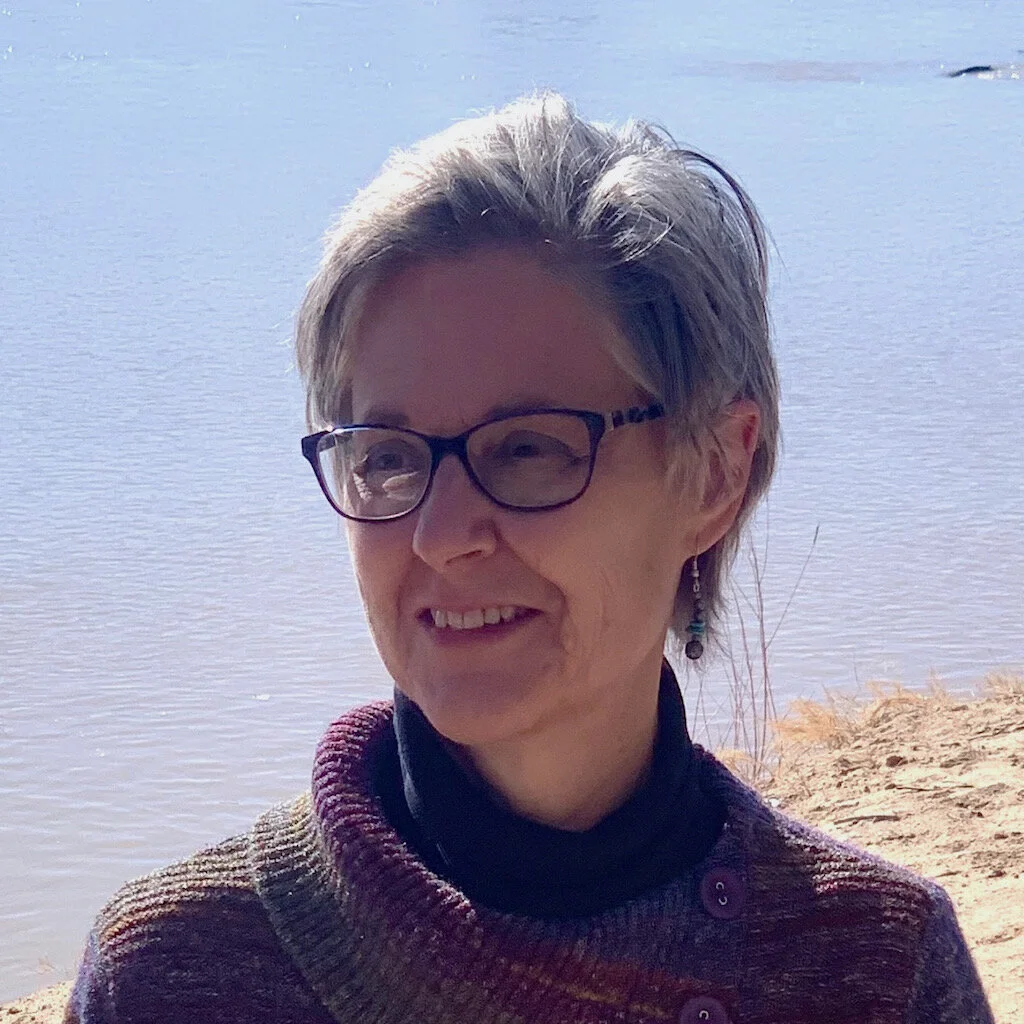
Kathryn Paul
Photo by Andrew Givhan
Kathryn Paul (Kathy) is a survivor of many things, including cancer and downsizing. Her poems have appeared in Rogue Agent, Hospital Drive, The Ekphrastic Review, Lunch Ticket, Stirring: A Literary Collection, Pictures of Poets and Poets Unite! The LiTFUSE @10 Anthology. Her poem “Dementia Waltz” appears in the Spring 2021 Intima.
Shakespeare, Stanzas and How We Think About Death by Albert Howard Carter, III, PhD
When my sonnet “All Tuned Up” appeared (Spring 2021 Intima), I was asked to write about another piece published in the journal. I chose “I Picture You Here, But You’re There” (Spring 2020 Intima) by Delilah Leibowitz. Her poem and mine both explore how we think and feel about death.
Read moreThe Body in Bloom: Thoughts on Two Artworks by Simona Carini

(c) Floral Anatomy by Kristen Kelly. FALL 2018 Intima
As a writer, to give life to a story, I reach for my pen and notebook, craft words into images, lines, sentences. I find it inspiring to explore how other artists use their preferred media to tell stories. In my poem “Young Woman Listens to Cyndi Lauper During Dialysis” (Spring 2021 Intima), I open a window into an experience of eating disorder. In contrast, two artists in the Fall 2018 Intima show us how our body can be seen as a garden of elegant shapes and rich colors.
Read moreHow a Doctor Learns to Act: A Reflection by Claire Unis, MD
“Am I becoming / something unfamiliar?” asks Lauren Fields in her poem “My First Mask Was a White Coat” and in that simple question she brings back for me the struggle of becoming. With our first medical school clerkships we don white coats and mimic our preceptors: some false confidence here, a prayer for invisibility there. Silent reassurances never spoken aloud: It’s okay to pretend at doctoring. That’s how you learn.
Read moreHow Touch Affects Healing, a reflection by Wendy Tong
In her Field Notes essay “Hand Holding” (Fall 2019 Intima), Dr. Amanda Swain describes the experience of beginning her surgery rotation as a third year medical student. In the early days of the rotation, she feels an intense sense of being out of place within the “intricately choreographed dance” of the operating room. But when the next patient is wheeled in, Dr. Swain is reminded of how a nurse once took her hand before she underwent surgery, the touch conveying an unforgettable message of comfort during a time of deep vulnerability.
Read moreAuscultating Meaning: Reflections on the Heart of Medicine by Marc Perlman
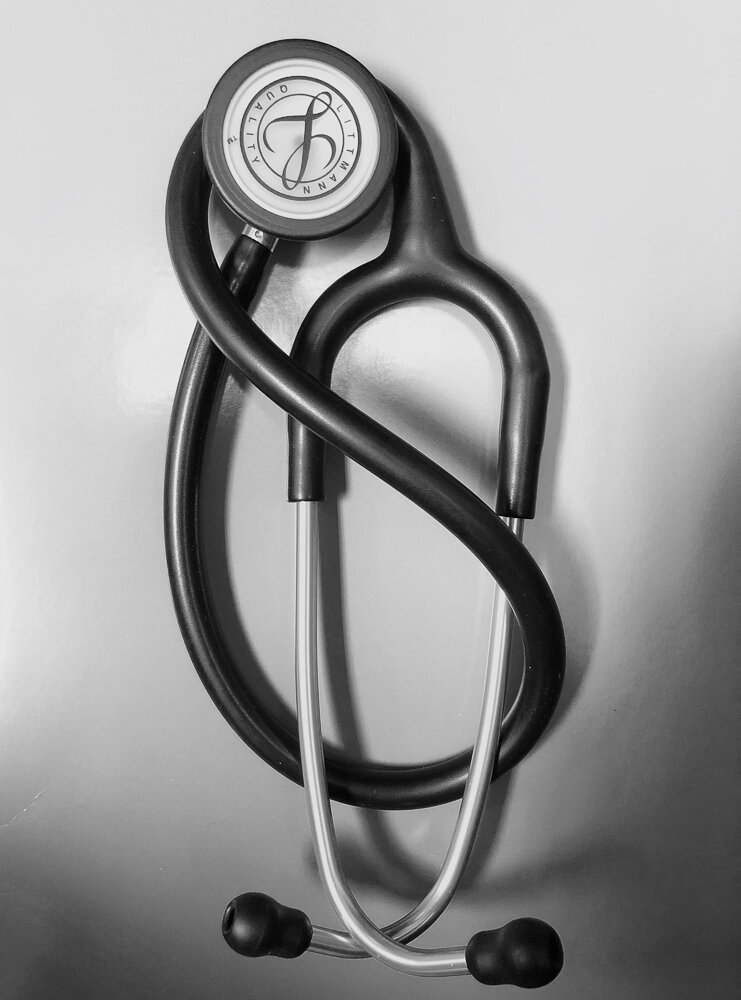
© Gordian Knot by Elisabeth Preston-Hsu Spring 2020 Intima A Journal of Narrative Medicine
From diaphragm to earpiece, a stethoscope dutifully chaperones a patient’s internal orchestra to a clinician’s ears. This facile acoustic communication not only allows a provider to screen for a wide host of cardiovascular, pulmonary and gastrointestinal anomalies, but it also may be a conduit for moral reflection.
Read moreHealing and Trauma: Recontextualizing Suffering by Sundara Raj Sreenath
Suffering due to trauma or illness often brings with it feelings of disconnect from the world as we knew it when we were healthy. The healthcare provider-healer, therefore, has an important opportunity to intervene in this unique setting and respond to the patient’s cry for help by offering a personal, humanistic touch and guiding them through trauma in addition to clinical management.
Read moreLife in the Gaps: How Illness Transforms Our Sense of Time by Renata Louwers
It was in those gaps, between our lived experience—the crushing uncertainty about how long my husband would live, the daily reality of his intolerable pain, and the abrupt shift from a life of joyful ease to one spent contemplating death—and the oncology profession’s standards of care, first-line treatments, and numeric pain scales that my frustration festered.
Read moreGrowth is Not Linear: A Reflection on Recovery and Healing by Sujal Manohar
I skimmed through “Eight Months after a Suicide Attempt” (Spring 2015 Intima) once as I perused articles in past issues of Intima. But I came back to it, read it again, and again. Andrea Rosenhaft’s non-fictional and personal narrative speaks to the nonlinear recovery process after mental illness. It is also a deeply vulnerable account of the realities of suicidal depression.
Read moreBecoming the Superheroes Our Parents Need: The Journey from Child to Worthy Caretaker by Usman Hameedi
Our parents are often our first examples of superheroes. They make gourmet meals from minimum wage, give hugs that vanquish our demons, and provide limitless love. They are impervious to damage or decay and are always ready to save our days. So, seeing the human in them, the mortality in their breath is unsettling. When they come to need us, we feel so grossly unprepared.
Read moreCaring for Our Caregivers: A short reflection by poet and hematology-oncology nurse Nina Solis
Caregivers deserve patience, gratitude and comfort just as much as those they support. As healthcare providers, we all could use a reminder to advocate for these irreplaceable members of a patient’s team.
Read morePoetry Helps Healing: Writing Poems on the Road to Recovery by Ellen Goldsmith
“Anatomy in Nature” is a gift that encourages appreciating the beauty and miracle of our bodies and the correspondence between forms in nature and what’s inside us—our heart, our lungs, our brain, our spine. What keeps us alive.
Anatomy Lesson: See the Face of Those Before You by Rodolfo Villarreal-Calderon, MD
For those with the privilege of having participated in a longitudinal cadaver dissection, the connection you build with the donor’s body is known to be a truly unique experience. That bond is part of what I attempted to capture in my poem “Through Damp Muslin.” Especially reflecting on how to express gratitude to the person who once was—and now who is, or at least whose body is—lying before you.