
A physician grapples with the tyranny of “normalcy” and how its unbending dictates can stifle the clinical encounter as well as patient care.
Read moreWhen Visuals Become Verbal: The Art of Communicating Emotional States of Mind by Barbara West
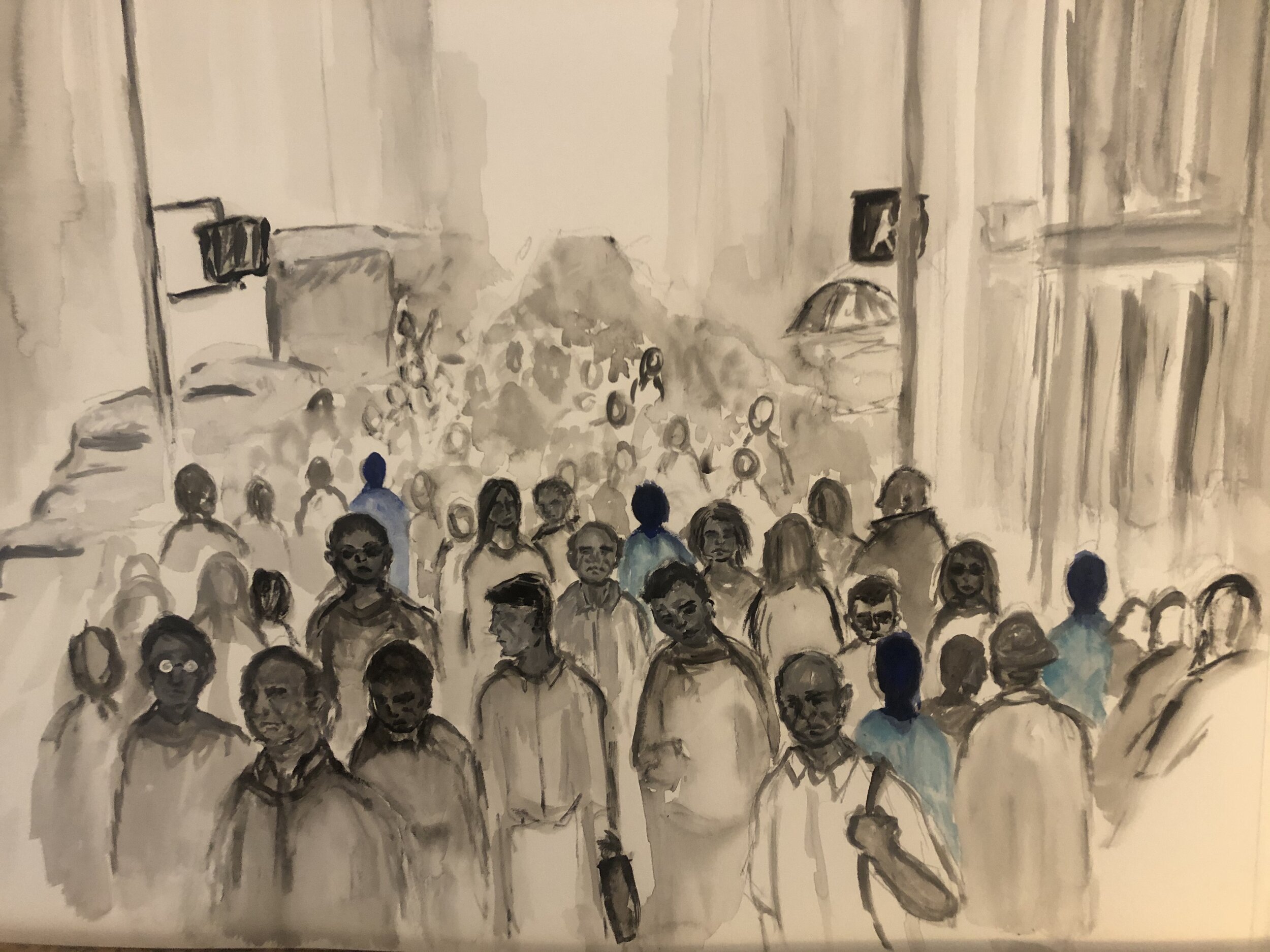
© Blue Pajama Series - Crowd by Rachel Wyman Fall 2021 Intima
A writer and hospice nurse explores the parallels between one of her essays published in Intima and a studio art series previously published in this journal.
Read moreOn Imagined Boundaries: A reflection on "the body as a narrative instrument" by Tony Errichetti
A medical educator reflects on studio art recently published in the Intima and examines the boundaries—real or imagined?—often constructed between mind and body.
Read moreGetting it Right, Even When it Feels Wrong: A Reflection by poet Ceren Ege
In his video “Inside Anxiety and Depression,” William Doan’s words “writing is drawing” were a reminder of my existence as a poet and artist, and how the latter is an identity I felt uncomfortable with for a long time. I squirmed at the creation of “art” out of another’s suffering, even though my father’s illness felt like the only thing worth writing about. Now I sit with a different question: whether anyone’s suffering is entirely separate. I think owning suffering defeats the very aim of why we move it to articulation—to release it, to divide the burden of it, and to comprehend it with others.
Read moreConnecting with the World of Our Patients: A Reflection by Savita Rani
In her poem “Internet Dating for Centenarians” (Intima, Fall 2021), Sarah Smith paints an animated picture of her cheeky and cheerful elderly patient. Smith, a board-certified family physician and author of The Doctor Will Be Late, describes her dilemma about which topic to discuss with her patient—lipids or love.
Read moreThe Body in Bloom: Thoughts on Two Artworks by Simona Carini

(c) Floral Anatomy by Kristen Kelly. FALL 2018 Intima
As a writer, to give life to a story, I reach for my pen and notebook, craft words into images, lines, sentences. I find it inspiring to explore how other artists use their preferred media to tell stories. In my poem “Young Woman Listens to Cyndi Lauper During Dialysis” (Spring 2021 Intima), I open a window into an experience of eating disorder. In contrast, two artists in the Fall 2018 Intima show us how our body can be seen as a garden of elegant shapes and rich colors.
Read moreAuscultating Meaning: Reflections on the Heart of Medicine by Marc Perlman
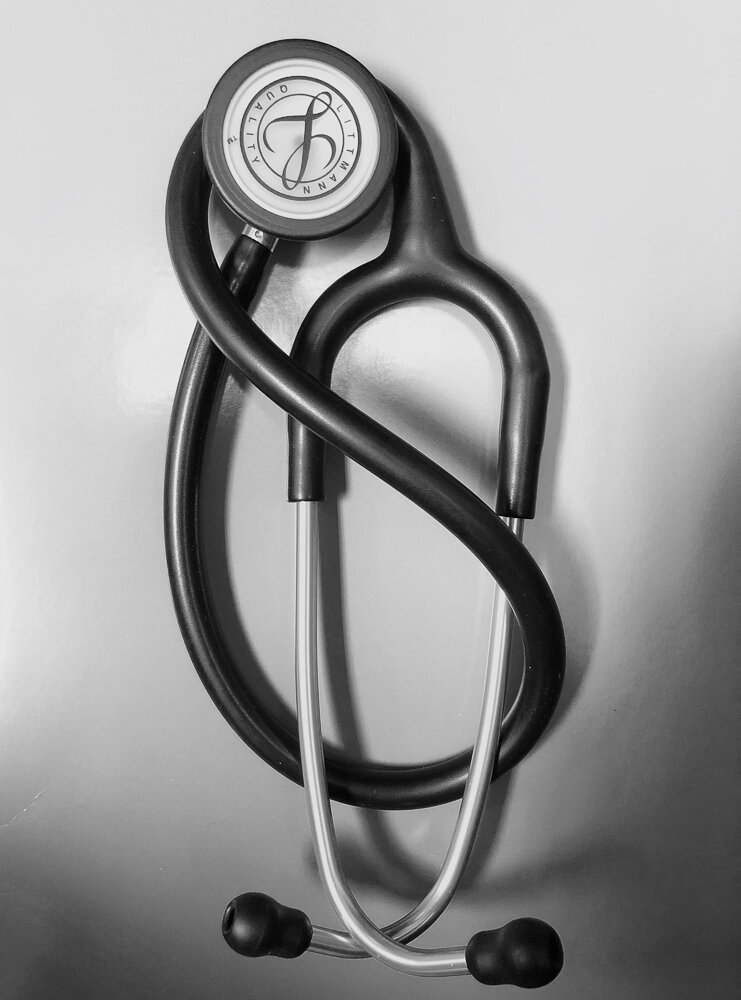
© Gordian Knot by Elisabeth Preston-Hsu Spring 2020 Intima A Journal of Narrative Medicine
From diaphragm to earpiece, a stethoscope dutifully chaperones a patient’s internal orchestra to a clinician’s ears. This facile acoustic communication not only allows a provider to screen for a wide host of cardiovascular, pulmonary and gastrointestinal anomalies, but it also may be a conduit for moral reflection.
Read moreHealing and Trauma: Recontextualizing Suffering by Sundara Raj Sreenath
Suffering due to trauma or illness often brings with it feelings of disconnect from the world as we knew it when we were healthy. The healthcare provider-healer, therefore, has an important opportunity to intervene in this unique setting and respond to the patient’s cry for help by offering a personal, humanistic touch and guiding them through trauma in addition to clinical management.
Read moreReimagining Chaos in Art and Poetry by Selene Frost
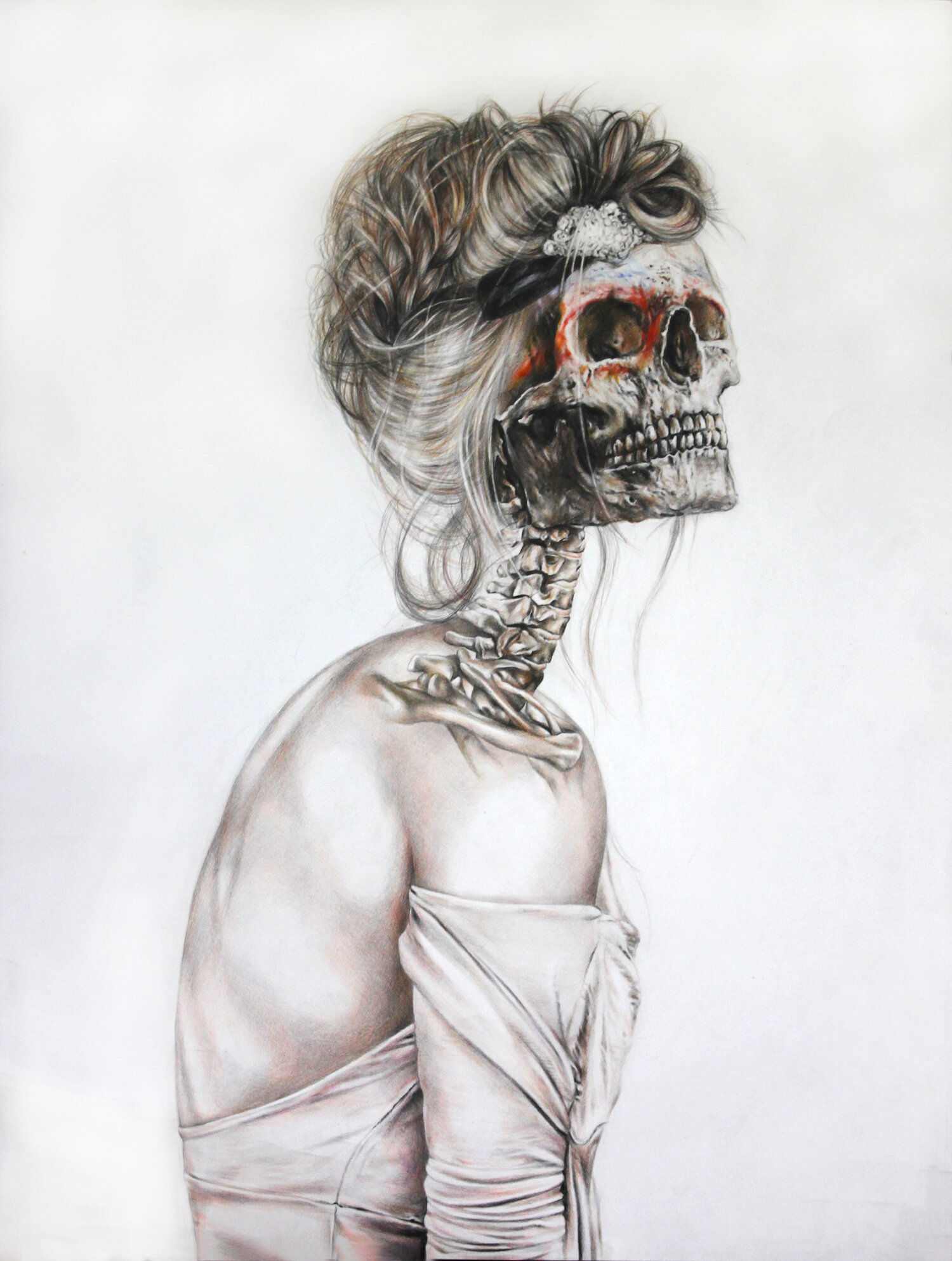
Anatomy of the Vogue by Meagan Wu. Fall 2017 Intima: A Journal of Narrative Medicine
I’ve long been fascinated by the way structure informs poetics and the practice (and in this case—reception of medical care). In my piece “Field Notes on Form,” I extol the ways in which linguistic structure has the remarkable ability to organize our thoughts, increase our signal within the noise, and etherealize the mundane. In “Post NICU Villanelle,” Joyelle McSweeney uses language not only to remediate the chaos of loss and of leaving but also to deconstruct both the poetic form and herself.
Read moreGrowth is Not Linear: A Reflection on Recovery and Healing by Sujal Manohar
I skimmed through “Eight Months after a Suicide Attempt” (Spring 2015 Intima) once as I perused articles in past issues of Intima. But I came back to it, read it again, and again. Andrea Rosenhaft’s non-fictional and personal narrative speaks to the nonlinear recovery process after mental illness. It is also a deeply vulnerable account of the realities of suicidal depression.
Read moreAnatomy Lesson: See the Face of Those Before You by Rodolfo Villarreal-Calderon, MD
For those with the privilege of having participated in a longitudinal cadaver dissection, the connection you build with the donor’s body is known to be a truly unique experience. That bond is part of what I attempted to capture in my poem “Through Damp Muslin.” Especially reflecting on how to express gratitude to the person who once was—and now who is, or at least whose body is—lying before you.
Thresholds and Transgressions, a reflection on ICU chaos, communitas, liminality and Levinas by Nancy Smith
Nancy Smith is a retired Registered Nurse. Though she moved through the many domains of hospital nursing, most of her work took place in an Intensive Care Unit. Her co-workers noticed that she would place small strips of paper with poems by various authors on her locker from time to time along with the pictures of her family.
Read moreHow to Hold Cold Hands by Laura-Anne White
I have spent my career as a nurse working with adult cancer patients. I, too, have experience with the self-protective tool of ‘numbing.’ Last spring, the COVID-19 pandemic hit New York City at full force, and I was temporarily transferred to an inpatient, COVID-19-positive cancer unit. I saw no one aside from co-workers, patients, and other essential workers.
Read moreSpeaking Truth: The Visual Arts Help Clinical Diagnosis by Virali Shah
As a society, we are driven by visuals. Advertisements. Social media. Logos. Paintings. Pictures. It is a 21st century skill to be “visually literate.” Only recently, however, the role of visual literacy has expanded into modern medical training.
Read moreThe Practice of Prolonging Death, a reflection by palliative care physician Chris Schifeling
“Would we rather die too soon or too late?”
The taboo of talking about death combined with a faith in the insomnia of medical technology leads many to err far on the side of dying too late.
Read moreFinding What's Essential in Just Laundry: Painting and Poetry in Dialogue By Alexis Rehrmann
In both the painting and the poem, these particulars are gone but the objects remain and hold an impression of that past life. There’s honor in caring for these objects, in both our daily work and our creative lives.
Read moreOn (Un)Knowing: A Reflection on the Imagination and the Body by poet Michelle Dyer

©What Lies Beneath by Sapana Adhikari Spring 2020 Intima A Journal of Narrative Medicine
As I lay on the table while the doctor poked and prodded inside my breast, clipping the lump inside me like flower stems, I imagined what the thing might look–what, exactly, lay beneath, and if it had a name.
Read moreMy COVID Hero: How Art Helped Me Reflect on a Global Pandemic by Dr. Brandon Mogrovejo
One late evening, just two months into my intern year in Pediatrics and seven months into a forever changed New York City, I sat down and drew. I drew from a place of anxiety, working the equivalent of two full-time jobs in a hospital during a time when the people I care for, my loved ones and my patients, were under great strain.
Read more‘Differential Diagnosis’ Can Be A Lifesaver, a Reflection by Colleen Corcoran

© Differential Diagnosis by Yan Emily Yuan Spring 2020 Intima A Journal of Narrative Medicine
Accurate differential diagnosis can save a life. By being able to determine clearly how one outlying factor or the combination of a group of signs and symptoms tips the scale to the correct pattern confirmation and treatment, our lives can be shaped, saved and lost in this qualifying lens of time. It’s integral to the practice of medicine, but also in many ways to how we make decisions in life. A positive or negative result, a clustering of symptoms, the ticked boxes and specimen samples that can reveal so much as to how we define our experiences of life and are able to move forward.
Read moreIn This Time of Corona: Many Stories, Many Lives, a reflection by surgeon Daly Walker
Sapana Adhkari’s “Covid’s Agony,” an evocative and gruesome depiction of the sagittal section of a human head screaming in agony, represents, in a single image, the anguish seen in the corona-captured characters of my short story, “Resuscitation.”
Read more