
As a medical student, I've gotten into the habit of saving folded-up scrap paper from the hospital and stealing moments during rounds or lectures to jot down scattered words and phrases. They're things I can't get out of my head, like "white cheddar Cheez-its® and stale cigarettes" or "I'm not a bad Mom." Snippets that don't make sense on their own, but together they have a strange sort of alchemy. The distilled essence of a day's humanity. A tragicomic piece of found poetry. After my first year of clinical rotations, I decided to sit down and see what I could cobble together to find out whether meaning would come if I made space for it. What arrived was, if not meaningful, at least interesting, and it eventually became "Self Portrait of the Artist as Medical Student."
Read moreBeyond Acronyms: Contemplating what 'OLD CARTS' really stands for by Tulsi Patel
“OLD CARTS” is an acronym we’re taught in medical school to guide us on questions to ask to elicit a history of the patient’s illness: Onset, Location, Duration, Characteristics, Aggravating or Alleviating factors, Radiation (of pain), Treatment, and Significance. Although OLD CARTS is a helpful checklist initially, over time it begins to feel perfunctory, done to check off a requirement on the rubric. We ask many questions, and I am keenly aware I’m asking because I want something from the patient—I want telltale signs, any clues on the diagnosis, any information that the care team can act upon and use— I feel greedy.
Read moreGetting it Right, Even When it Feels Wrong: A Reflection by poet Ceren Ege
In his video “Inside Anxiety and Depression,” William Doan’s words “writing is drawing” were a reminder of my existence as a poet and artist, and how the latter is an identity I felt uncomfortable with for a long time. I squirmed at the creation of “art” out of another’s suffering, even though my father’s illness felt like the only thing worth writing about. Now I sit with a different question: whether anyone’s suffering is entirely separate. I think owning suffering defeats the very aim of why we move it to articulation—to release it, to divide the burden of it, and to comprehend it with others.
Read moreOut of Time? A reflection about illness and its toll on our past, present and future by Sophia Wilson
In her observant poem “Brain as Timepiece (Administering the Clock-Drawing Test to My Patient With Dementia)” (Intima, Fall 2018), Jennifer Wolkin describes the disordered clockface drawn by a patient with dementia: each number stands outside its perimeter like lost digits. The patient’s subsequent drawing of an ‘X’ over the wayward numbers suggests an erasure, not only of cognitive function, but of time itself. Time’s toll equates to a ‘crossing out’ of past, present and future as the ‘disease devours …organ tissue’.
Read moreA Simple Ritual: Reflecting on the Moments Before Surgery by poet and orthopedic surgeon Photine Liakos
Surgeons are well-known for precision and protocols. There is often a ritual nature to our actions when preparing for surgical interventions, an orderliness and discipline: checklists, time-outs, pauses, consensus.
Read moreThe Shit Poems: A Reflection by Drea Burbank
I am interested in the juxtaposition between my use of poetry to shed traumatic experiences and memories from medicine, and the description of William Carlos Williams by Britta Gustavson (“Re-embodying Medicine: William Carlos Williams and the Ethics of Attention,” Spring 2020 Intima).
Read moreMothers and Daughters: A Reflection on Cancer, Caring and Seeing the Whole Picture by poet Kathryn Paul

—After ‘Macroscopic” by Adela Wu (Spring 2021 Intima)
My mother and I were not close. I knew she wanted us to be, but I couldn’t do it her way. For most of my adult life, I kept my distance, emotionally and physically. We lived on opposite sides of the continent. In her 80’s, the creeping dementia my mother never discussed was overtaken by a cruel and much more terrifying diagnosis: Stage IV ovarian cancer.
Aided by her cancer-free twin sister, Mom endured multiple surgeries and two lengthy and debilitating rounds of chemo. Each time, her cancer came roaring back within weeks. Her surgeon suggested an experimental Round Three. Mercifully, her oncologist suggested hospice at home instead.
During the first year of Mom’s illness, I was trapped by my own cancer treatment, unable to participate in her care. I called daily, spoke with her, spoke with my aunt, asked about her pain, her “tummy trouble,” her ascites, and her white count. I took notes and dictated the questions to ask at her next appointment.
As soon as my doctors cleared me to visit her, I did. I was always on the verge of moving in with her, but never quite needed to do so. I flew back and forth. The more debilitated she became—by her cancer and her dementia—the more often I visited.
Adela Wu’s Studio Art piece “Macroscopic” simply and eloquently captures the changes in how I experienced my mother during those last months and weeks. The simplest things gave her joy: A small dish of ice cream. A pain-free nap on the down-stuffed cushions of her couch. Cuddles with her cats. A bird visiting the feeder outside her window.
Even as her disease spread through her body, even as she faded, my mom seemed to crystallize. She became, ultimately, the Essence of herself. And—just at the end—I finally saw her.
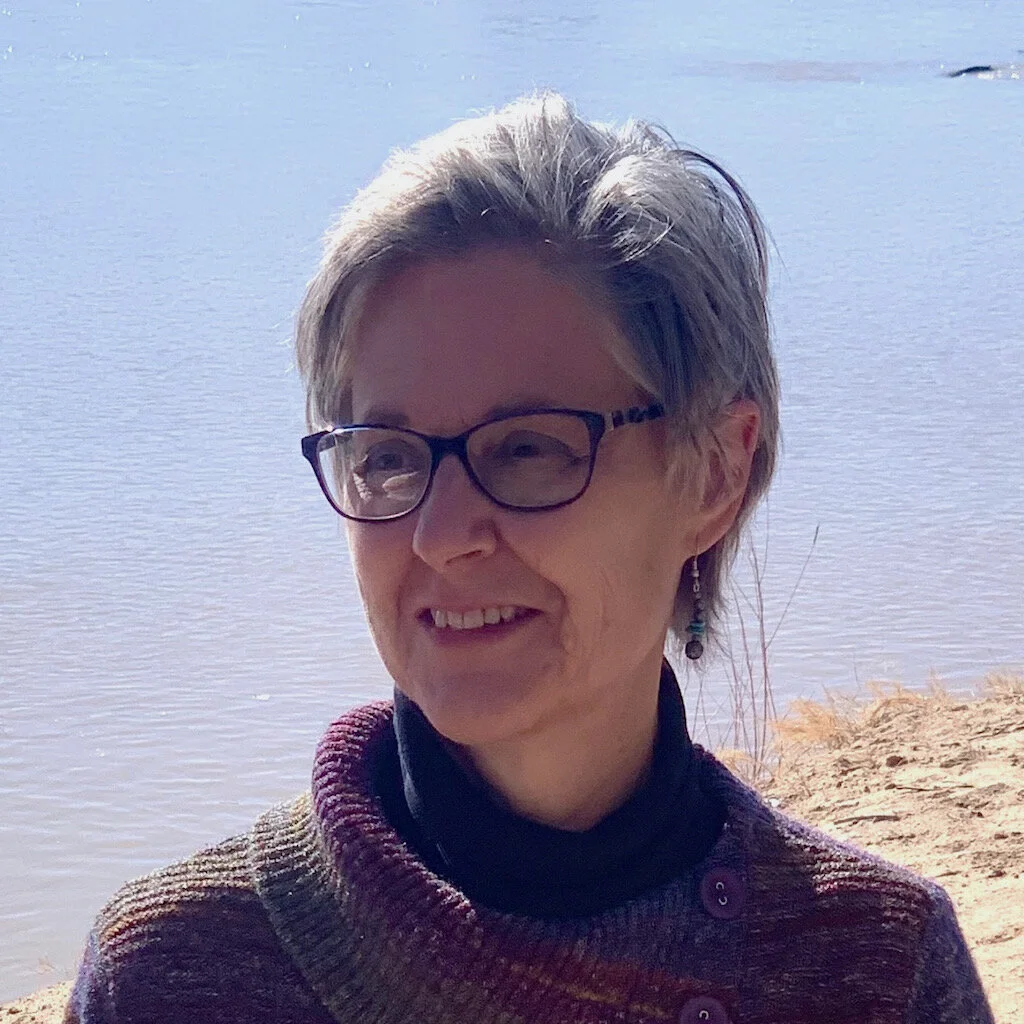
Kathryn Paul
Photo by Andrew Givhan
Kathryn Paul (Kathy) is a survivor of many things, including cancer and downsizing. Her poems have appeared in Rogue Agent, Hospital Drive, The Ekphrastic Review, Lunch Ticket, Stirring: A Literary Collection, Pictures of Poets and Poets Unite! The LiTFUSE @10 Anthology. Her poem “Dementia Waltz” appears in the Spring 2021 Intima.
The Body in Bloom: Thoughts on Two Artworks by Simona Carini

(c) Floral Anatomy by Kristen Kelly. FALL 2018 Intima
As a writer, to give life to a story, I reach for my pen and notebook, craft words into images, lines, sentences. I find it inspiring to explore how other artists use their preferred media to tell stories. In my poem “Young Woman Listens to Cyndi Lauper During Dialysis” (Spring 2021 Intima), I open a window into an experience of eating disorder. In contrast, two artists in the Fall 2018 Intima show us how our body can be seen as a garden of elegant shapes and rich colors.
Read moreHow a Doctor Learns to Act: A Reflection by Claire Unis, MD
“Am I becoming / something unfamiliar?” asks Lauren Fields in her poem “My First Mask Was a White Coat” and in that simple question she brings back for me the struggle of becoming. With our first medical school clerkships we don white coats and mimic our preceptors: some false confidence here, a prayer for invisibility there. Silent reassurances never spoken aloud: It’s okay to pretend at doctoring. That’s how you learn.
Read moreOn Fathers, Love and “Exit Wounds” by psychiatrist and essayist Greg Mahr
I regularly attend a poetry critique group in Ann Arbor, MI called the Crazy Wisdom Poetry Circle, named after the bookstore and tea shop where we used to meet before the pandemic. The experienced poets there have come to accept the sad and overly personal poems and flash pieces I write and help me craft them into something that sometimes almost sounds like real writing. One of them once told me, “You always write from a place of longing. That’s a good place to write from.” I realized he was right. I find it hard to share what I write with the people I love. When I am in a good relationship, I write about bad ones; when I love someone, I write about missing them.
Read moreCaring for Our Caregivers: A short reflection by poet and hematology-oncology nurse Nina Solis
Caregivers deserve patience, gratitude and comfort just as much as those they support. As healthcare providers, we all could use a reminder to advocate for these irreplaceable members of a patient’s team.
Read morePoetry Helps Healing: Writing Poems on the Road to Recovery by Ellen Goldsmith
“Anatomy in Nature” is a gift that encourages appreciating the beauty and miracle of our bodies and the correspondence between forms in nature and what’s inside us—our heart, our lungs, our brain, our spine. What keeps us alive.
Memory, Dementia and Finding ‘Original Happiness’: A Reflection by Rhiannon Weber

They Tell Me It's Normal Grief by Makoto Ogawa. Spring 2018 Intima
What if a loved one losing their memory made them happier with themselves, others, the world? If all their past abuses, transgressions, phobias, biases, etc. slowly faded away and a smile emerged? Not a senseless smile of ignorance or foolishness but of peace, patience, and serenity…could we accept this?
Read moreAnatomy Lesson: See the Face of Those Before You by Rodolfo Villarreal-Calderon, MD
For those with the privilege of having participated in a longitudinal cadaver dissection, the connection you build with the donor’s body is known to be a truly unique experience. That bond is part of what I attempted to capture in my poem “Through Damp Muslin.” Especially reflecting on how to express gratitude to the person who once was—and now who is, or at least whose body is—lying before you.
Thresholds and Transgressions, a reflection on ICU chaos, communitas, liminality and Levinas by Nancy Smith
Nancy Smith is a retired Registered Nurse. Though she moved through the many domains of hospital nursing, most of her work took place in an Intensive Care Unit. Her co-workers noticed that she would place small strips of paper with poems by various authors on her locker from time to time along with the pictures of her family.
Read moreFinding What's Essential in Just Laundry: Painting and Poetry in Dialogue By Alexis Rehrmann
In both the painting and the poem, these particulars are gone but the objects remain and hold an impression of that past life. There’s honor in caring for these objects, in both our daily work and our creative lives.
Read moreGlobal Citizenship: The Complex Emotions of ‘Going Home’ to a Place You’ve Never Been by Violet Kieu
Going to Vietnam was a formative time of my life–and also a reminder I am not entirely of that place. I am distance, and culture and language apart. Doing a medical elective in Saigon was a paradox: both familiar and foreign.
Read moreRemembering Fathers: Raspberry Picking, the Silence of Roses, and Taking a Breath: A reflection on two poems by Mark Hammerschick
Memory serves as an anchor in our lives, those brief, isolated moments of awe create a sense of warmth, safety, comfort.
Read moreFire, Cake and Stone: A Wayfarer’s Guide to Remembering by Deborah Burghardt
Though different cultures and different pastries, the narrator and I both bake in our memories. We share the human desire to displace grief and make our sweetest moments last.
Losing Touch: How COVID-19 Has Interfered With the Way We Bond by Adam Lalley, MD
The intimacy of touch is deeply rooted in vulnerability, and COVID-19 is reminding us that this vulnerability is biological as well as emotional. For Dr. Vlasic, touch was an act of trust, but nowadays trust seems best measured by how far apart we stand and how carefully we obscure the lower half of our faces.
Read more