
On Bodies and Minds: A Reflection on Raina Greifer’s Artwork 'Bodies' by Diane Forman

Raina Greifer’s artwork “Bodies” (Spring 2018 Intima) compels viewers to confront their own preconceptions and biases about body form. Her three headless, faceless bodies, of various sizes and depths, present a seemingly endless network of intertwined organs and bones, of breastplates and intestines and veins. Greifer urges the viewer to consider vulnerability, in the context of these drawings.
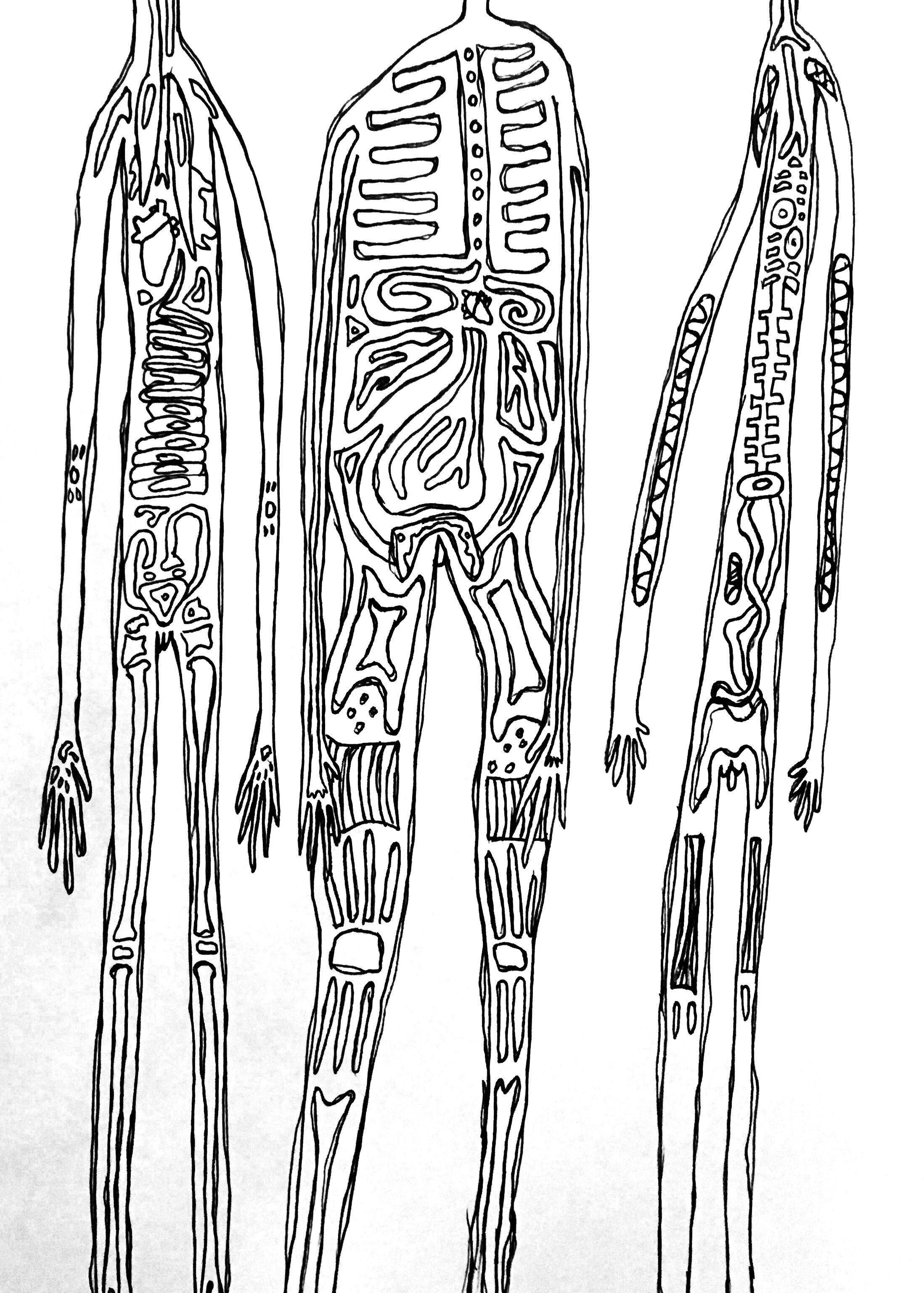

©Bodies by Raina Greifer. Spring 2018 Intima

©Bodies by Raina Greifer. Spring 2018 Intima

Of course the body is much more than a composite of bones and organs, but a human cannot survive without the exquisite interplay of these parts. Greifer’s drawing asks me to consider not only the body’s intricate internal structure, but the external form shown to the world. Although the drawings are deliberately missing heads, the artist highlights the theme of vulnerability, which can only be contemplated through the integral component of the mind. Our minds magnify our vulnerability; our thoughts determine how we visualize ourselves, how we feel in our own skin.


After a lifetime of my own struggle with body dysmorphia, I was forced to confront both the mind and body’s strength and fragility when dealing with my daughter’s restrictive eating disorder, explored in my piece “Holding my Breath” (Spring 2020 Intima). Helplessly, I witnessed the ways in which the body fails without sufficient nutrition; how the body is reduced to conserving energy for the heart, brain, muscles, digestion. The body truly becomes a vessel of organs and bones all vying to survive.

But the starved mind is trying to survive too. Recovery is dependent on replenishing not only the organs with required energy, but the mind with recognition of the body's miracle and potential, whatever its size. I value Raina Greifer’s artwork, which encourages me to consider the vulnerability of the mind, and its intimate connection with the complexity of the body.


Forman, Diane.jpg

Diane Forman is a writer and educator. After a long career as writing tutor and educational consultant, Forman is currently working on a series of essays and a memoir. Additionally, she leads adult writing groups and retreats on the north shore of Boston. She holds a BS in English and Education from Northwestern University, and an Ed.M. from the Harvard Graduate School of Education and is an AWA affiliate, trained and certified to lead workshops in the AWA (Amherst Artists and Writers) method. Her non-fiction essay “Holding My Breath” appeared in the Spring 2020 Intima: A Journal of Narrative Medicine.

Poetry and Music: How Each Word in a Poem Reflects an Emotion by Anna Delamerced

Life is full of joy and sorrow. The melodies of life involve not only high moments, but low ones, too. My grandmother has lived through more than ninety decades. In those years she has endured war, found love, mourned the loss of relatives, suffered illness, survived a train crash, and discovered new happiness in grandchildren.

 Each day carries a crossroads of pain and hope, suffering and healing. In my poem Evening Music, I sought to portray these crossroads. Words like “pillow”and “wooden bench” were written in the same line to juxtapose the softness and harshness of life. “Paper fan” and “electric fan” are used to show the fragility and strength in my grandmother. I wrote the final line, “She plays the piano even in the dark” to show that even if my grandmother has suffered much, she still sees light in the dark and makes something beautiful.

Ellen Sazzman’s poem Assisted Living Lullaby (Fall 2016 Intima) resonated with me and echoed similar sentiments. The words “lullaby” and “assisted living” brought together images of youth and old age in my mind. Life seems cyclical, as we sing lullabies to both infants and seniors. Music compels us to meditate on life, stirring memories of a wide breadth of emotions, from sad memories to happy ones.

Working in the medical world has reiterated the juxtaposition of the sorrows and joys of life. Each day in the hospital sees both life and death. How do we navigate all this? Do the sorrows make the joys all the sweeter? I do not have all the answers, but perhaps it is in poetry where I can wrestle with these thoughts and experiences. Writing allows us to wade in the gray, to make music in the dark.

Delamerced%2C+Anna.jpg

Anna Delamerced is a medical student at the Warren Alpert Medical School of Brown University. She received funding through the Bray Medical Humanities Fellowship to pursue a year-long project, focusing on poetry for kids in the hospital. Her works have been published in KevinMD, Medscape, Abaton, Plexus, Murmur, Cornerstone and in-Training. She is passionate about listening to people tell their stories. Her poem “Evening Music” appears in the Spring 2020 Intima.

The Body Politic: Fashioning our own earthly justice in a challenging time by Adam Lalley

In the short story “Good As New” by Andrew Taylor-Troutman in the Spring 2020 Intima, the site of a teenager’s accidental death becomes a healing destination. At the little white cross beneath an oak tree, cancer is cured and the wounded throw off their wheelchairs. But when a line of pilgrims stretches into the next county, the miracle dries up.

Some, but not all, are restored. The inequity mirrors the disparities of our very own bodies— our health, even the lengths of our lives, are doled out unequally. There’s no earthly justice in our bodies.

Read more

Seeing is Believing: Reflecting on Miracles by Andrew Taylor-Troutman

A reflection on “My Grandpa” by Meghan Wang (Poetry / Spring, 2013)

I see his body, but I do not see him

So begins Meghan Wang’s poem and her words cut to the core of the grief I have known in watching an aged loved one. I have lost people before their actual deaths. I know that sight is a metaphor for understanding. That is the double-meaning of the poem’s line:

It’s hard to see him like this

Read more

A Physician's Response in an Emergency: Humility Complements Competence by Rachel Fleishman

Watching a medical emergency as a physician who is not functioning as a leader or caretaker unearths discomfort, a mingling of denied identity with humility. And it is from this vantage that we can harness the power of narrative medicine to create space for reflection, to make sense of medicine and how it unfolds.

Read more

Aging and Memory from Two Poetic Perspectives: A Reflection by Larry Oakner

As I age into my late sixties, I’m experiencing the blips of short-term memory loss that are common for many people my age. I find the experience a little frightening and disconcerting because I have always had great recall throughout my life, with deep detail and clarity of memories, right down to the emotions at the time.

Read more